Monte Carlo methods

Rob Trangucci

Attribution

Floating point representation

  • Mathematical theorems deal with constructs like \(\R\), but when we’re computing things, we need to contend with limited accuracy

  • In 64-bit computing, we have 1 bit to determine the sign of the number, 11 bits for the exponent and 52 bits for the mantissa (all of these are in binary): \[ 1.2345 \times 10^5 \]

  • This would be \(12{,}345\) in floating point

  • Because of this representation, we can represent numbers near \(0\) very accurately, and we lose accuracy as we increase the magnitude

  • Smallest number we can represent is about \(2.2\times 10^{-308}\), while closest value to \(1\) is around \(1 \pm 2.2 \times 10^{-16}\)

pbeta(0.5, 241945, 251527)
[1] 1
pbeta(0.5, 241945, 251527, lower.tail = FALSE)
[1] 1.145624e-42

Dealing with denisties in computing

  • Because we have limited accuracy, we can’t always compute things the way we write them mathematically

  • For example, suppose we want to evaluate the likelihood for \(600\) data points we assume come from a normal distribution:

\[ \begin{aligned} y_i \mid \mu & \overset{\text{iid}}{\sim} \text{Normal}(\mu, 1), i = 1, \dots, 600 \\ p(y \mid \mu) & = \prod_{i=1}^{600} \frac{1}{\sqrt{2 \pi}} e^{-\frac{1}{2}(y_i - \mu)^2} \end{aligned} \]

  • Writing this in R code, and evaluating \(p(y \mid 0)\) gives:
y <- rnorm(600)
prod(dnorm(y, mean = 0, sd = 1))
[1] 0
  • This is called underflow, when the target value exceeds the precision of floating point representation

  • Intead, we need to compute things on the log scale:

\[ \begin{aligned} \log p(y \mid \mu) & = \sum_{i=1}^{600} -\frac{1}{2} \log(2\pi) -\frac{1}{2}(y_i - \mu)^2 \end{aligned} \]

sum(dnorm(y, mean = 0, sd = 1, log = TRUE))
[1] -884.5807
  • In order to keep everything as stable as possible, compute \(\exp\) as late as you can in calculations

…Log-sum-exp trick

  • Suppose you want to compute the log-likelihood in for a mixture model with two components

  • The likelihood looks like \[ p(y_i \mid \theta) = \phi p(y_i \mid \eta_1) + (1 - \phi) p(y_i \mid \eta_2) \]

  • We just talked about the importance of keeping things on the log scale so we write: \[ \ell(y_i \mid \eta_1) = \log p(y_i \mid \eta_1) \]

  • Then our log-likelihood would be

\[ \begin{aligned} \log p(y_i \mid \theta) & = \log( \exp \lp \log(\phi) + \ell(y_i \mid \eta_1) \rp \\ \quad\quad & \exp \lp \log(1 - \phi) + \ell(y_i \mid \eta_2) \rp ) \end{aligned} \]

  • For arguments sake, suppose this evaluates to something like \(\log(\exp(800) + \exp(801))\)
log(exp(800) + exp(801))
[1] Inf
  • Instead we can write this as \(\log(\exp(800)(1 + \exp(801 - 800))\), or \(800 + \log(1 + \exp(1))\)
800 + log(1 + exp(1))
[1] 801.3133

Expectations

  • In Bayesian inference, everything is a posterior expectation:

\[ \ExpA{h(\theta)}{p(\theta \mid y)} = \int h(\theta)p(\theta \mid y)d\theta \]

\[ p(\theta \mid y) = \frac{\textcolor{green}{p(y \mid \theta) p(\theta)}}{\textcolor{red}{\int p(y \mid \theta) p(\theta) d\theta}} \]

  • We can typically evaluate \(\textcolor{green}{p(y \mid \theta) p(\theta)}\), but \(\textcolor{red}{\int p(y \mid \theta) p(\theta) d\theta}\) is hard to evaluate

  • Our strategy is to use what we can evaluate \(q(\theta \mid y) = p(y \mid \theta) p(\theta)\) to compute our target expectations

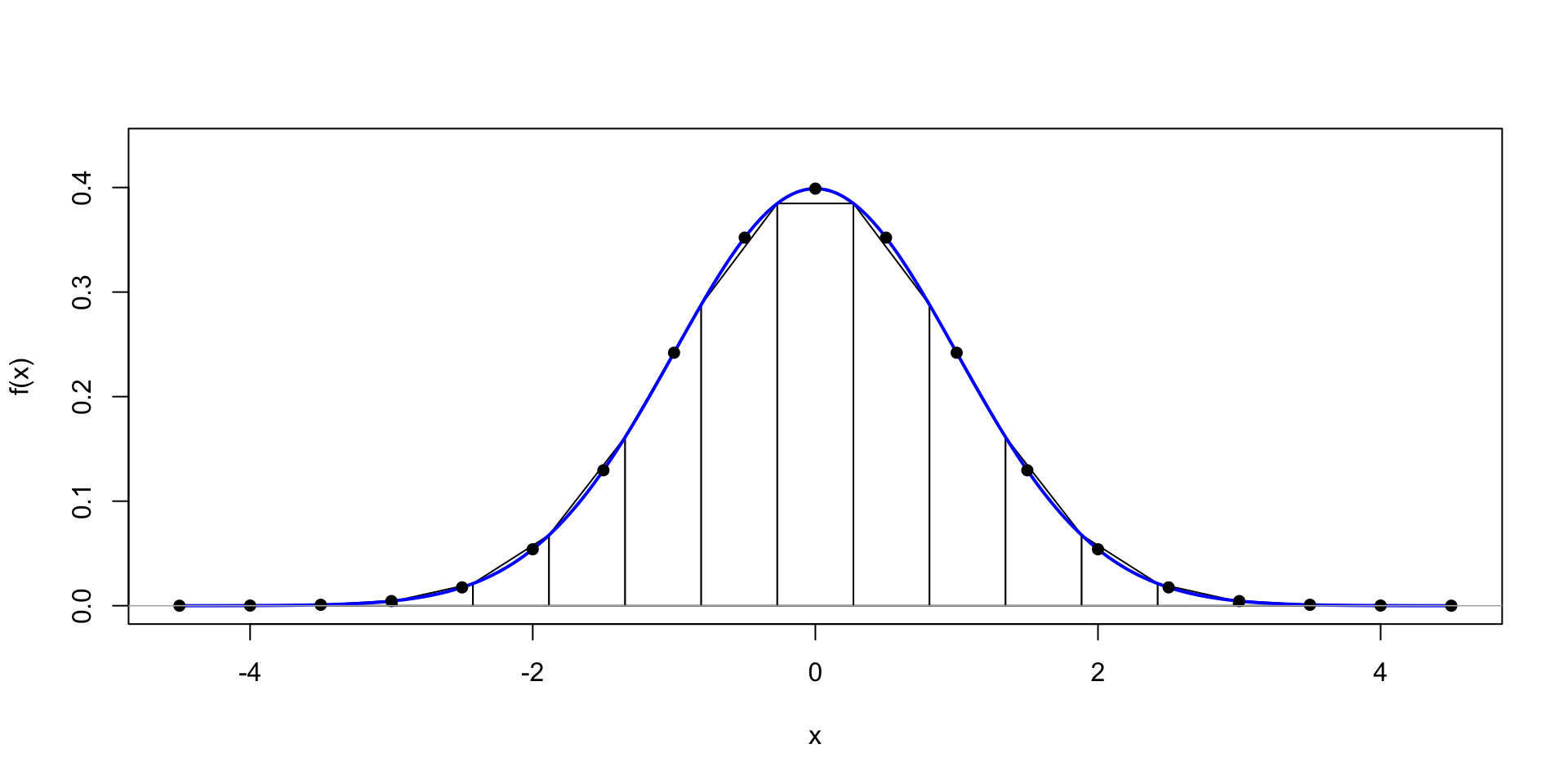
  • One option is to evaluate \(q(\theta \mid y)\) on a grid of \(\theta^{(s)}\) to get

\[ \ExpA{h(\theta)}{p(\theta \mid y)} \approx \frac{\sum_{s=1}^S h(\theta^{(s)}) q(\theta^{(s)} \mid y)}{\sum_{s=1}^S q(\theta^{(s)} \mid y)} \]

  • Another is to use \(q(\theta \mid y)\) to generate draws from the target density \(p(\theta \mid y)\) and to compute

\[ \ExpA{h(\theta)}{p(\theta \mid y)} \approx \frac{1}{S} \sum_{s=1}^S h(\theta^{(s)}) \]

Quadrature integration

\(\Exp{\theta} = \sum_{s=1}^S \theta^{(s)} w^{(s)}\)
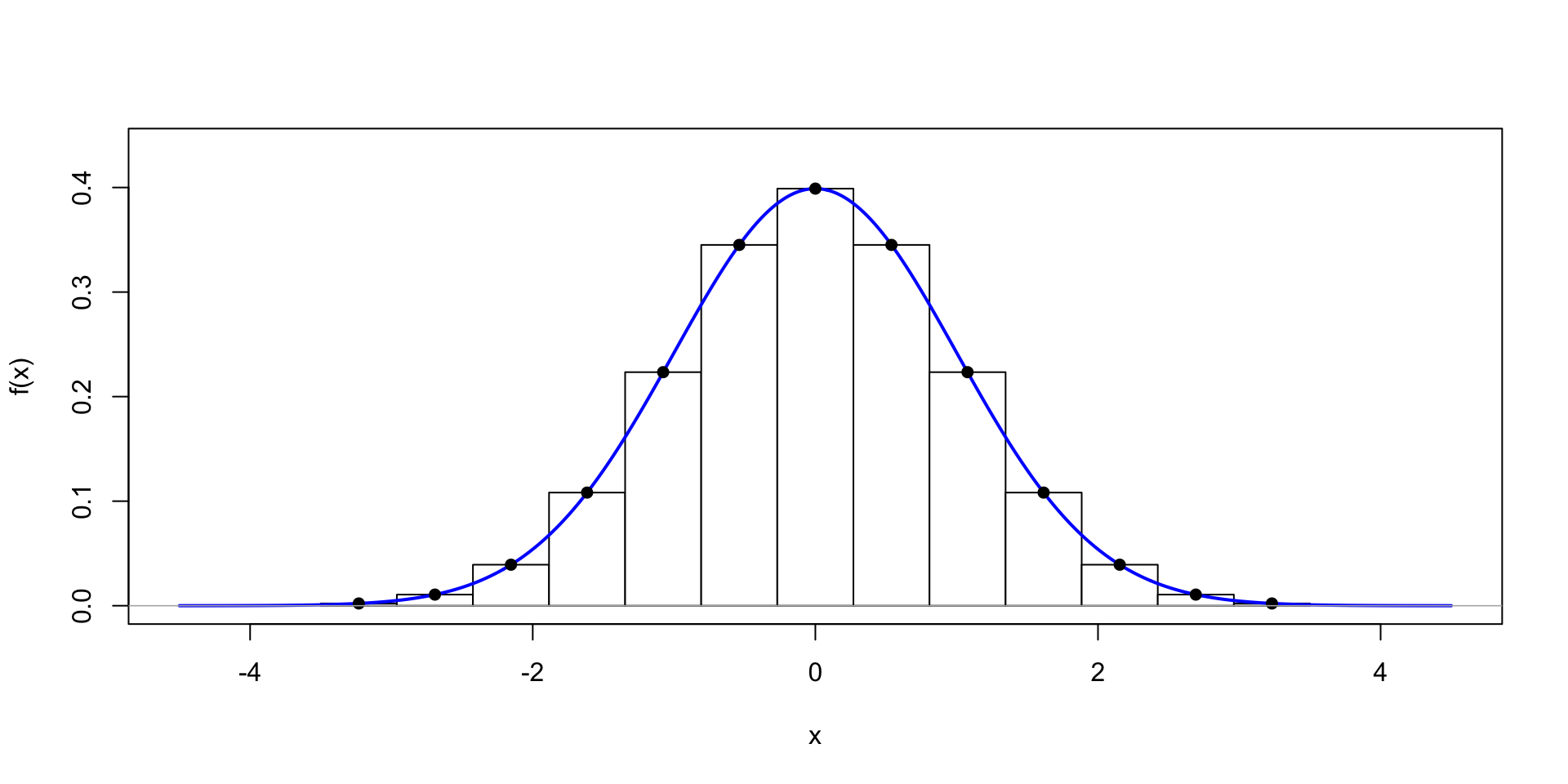
More sophisticated methods are available in R using the integrate function

Problems with grid methods

Evaluations increase exponentially as the dimension of the space increases \(c^d\)
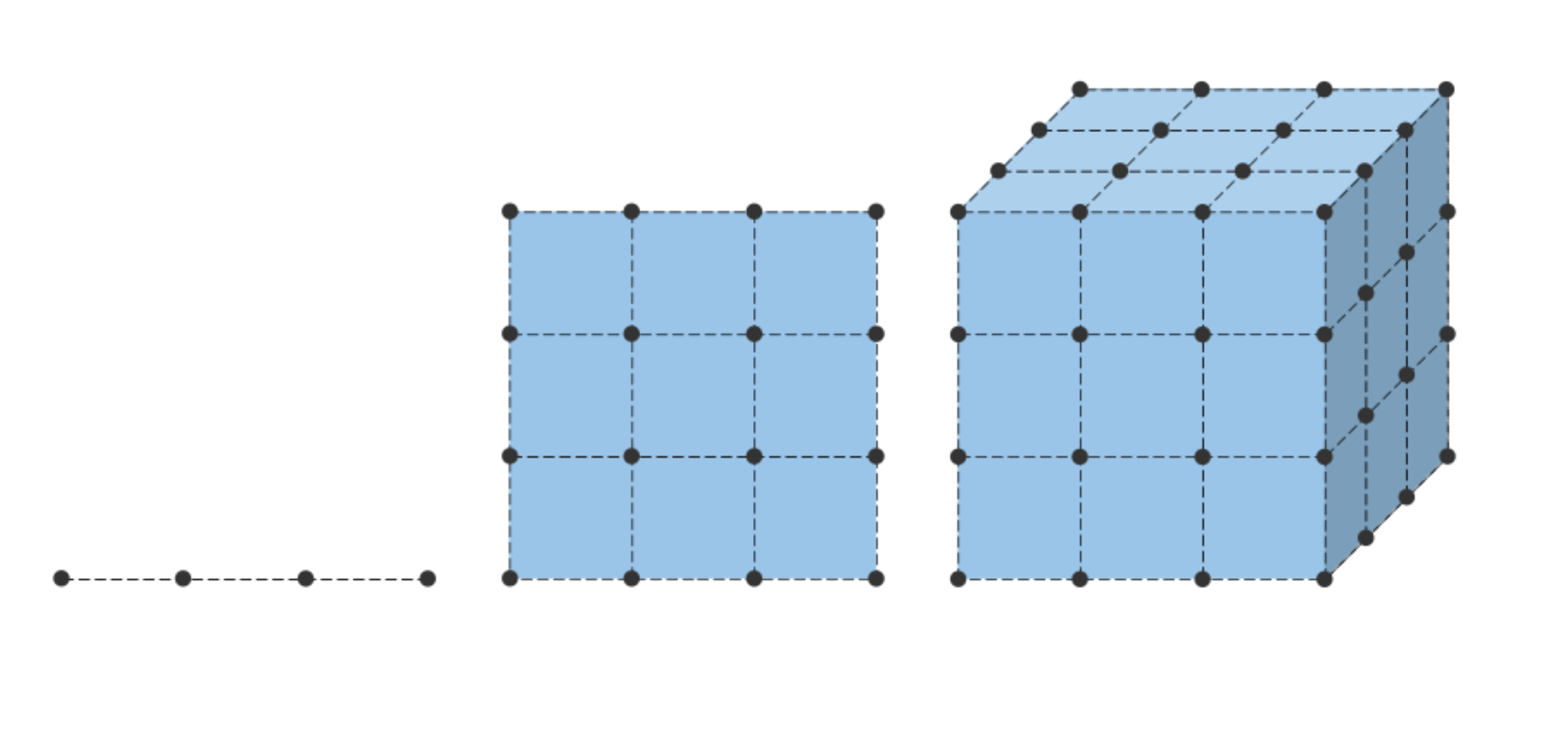
Curse of dimensionality

A significant hurdle in grid methods is that you have to define the grid before you know where the mass of the probability distribution

Approximate cost: Suppose we have \(50\) points in each dimension and \(10\) dimensions, this would require \(50^{10} \approx 1e17\) evaluations

Even with a fast computer, this could take years to evaluate
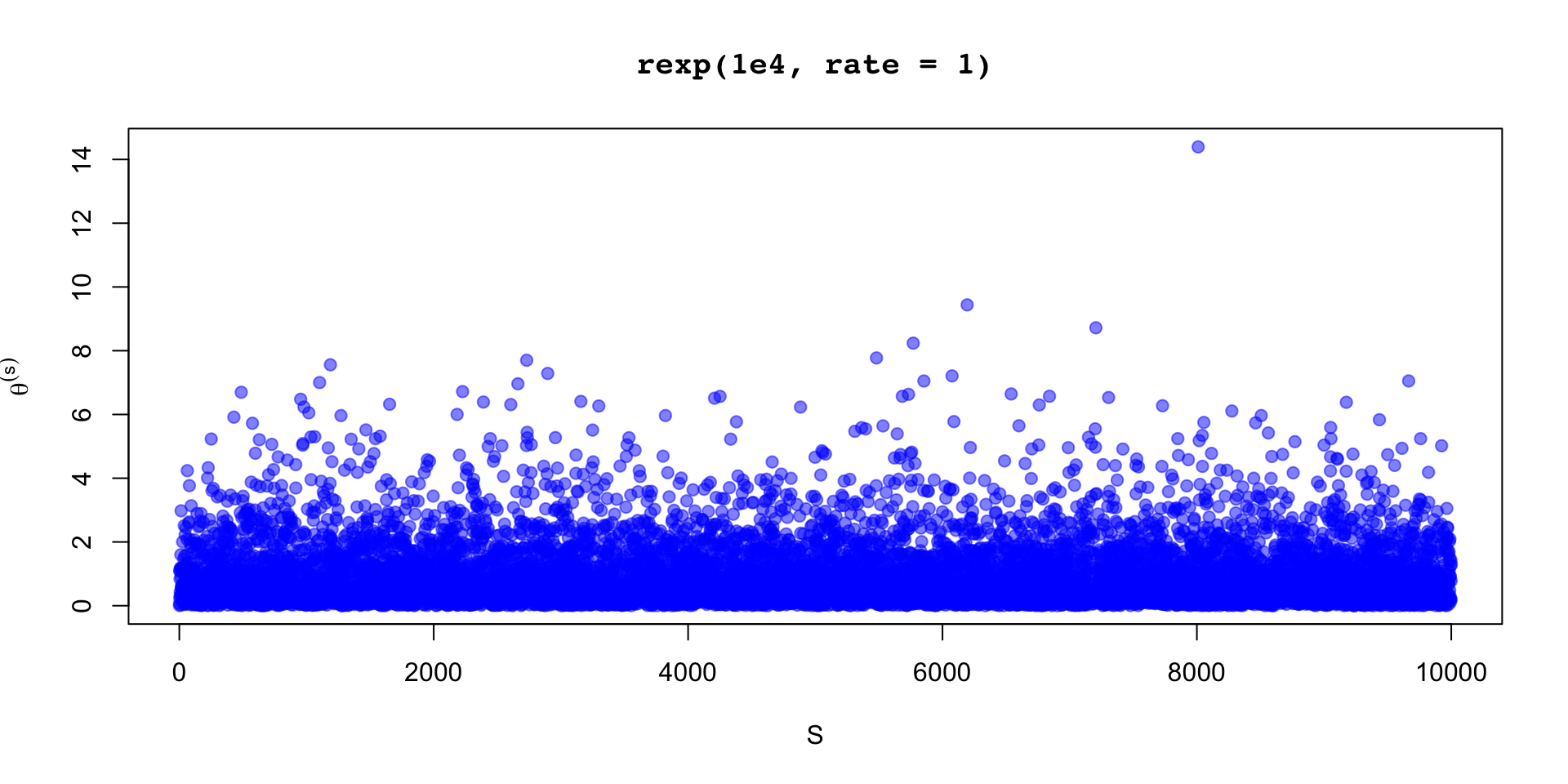
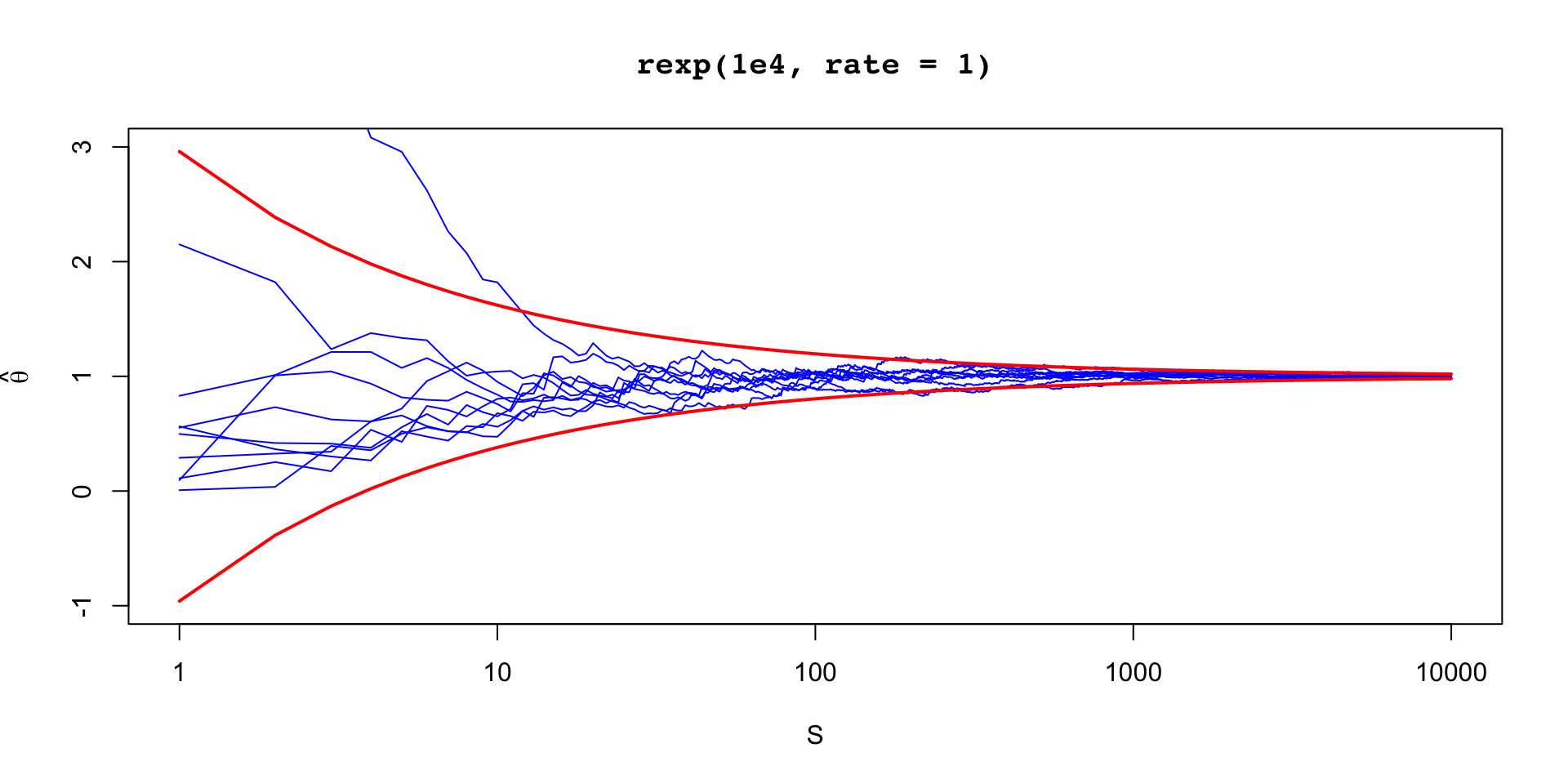
How many draws do we need?

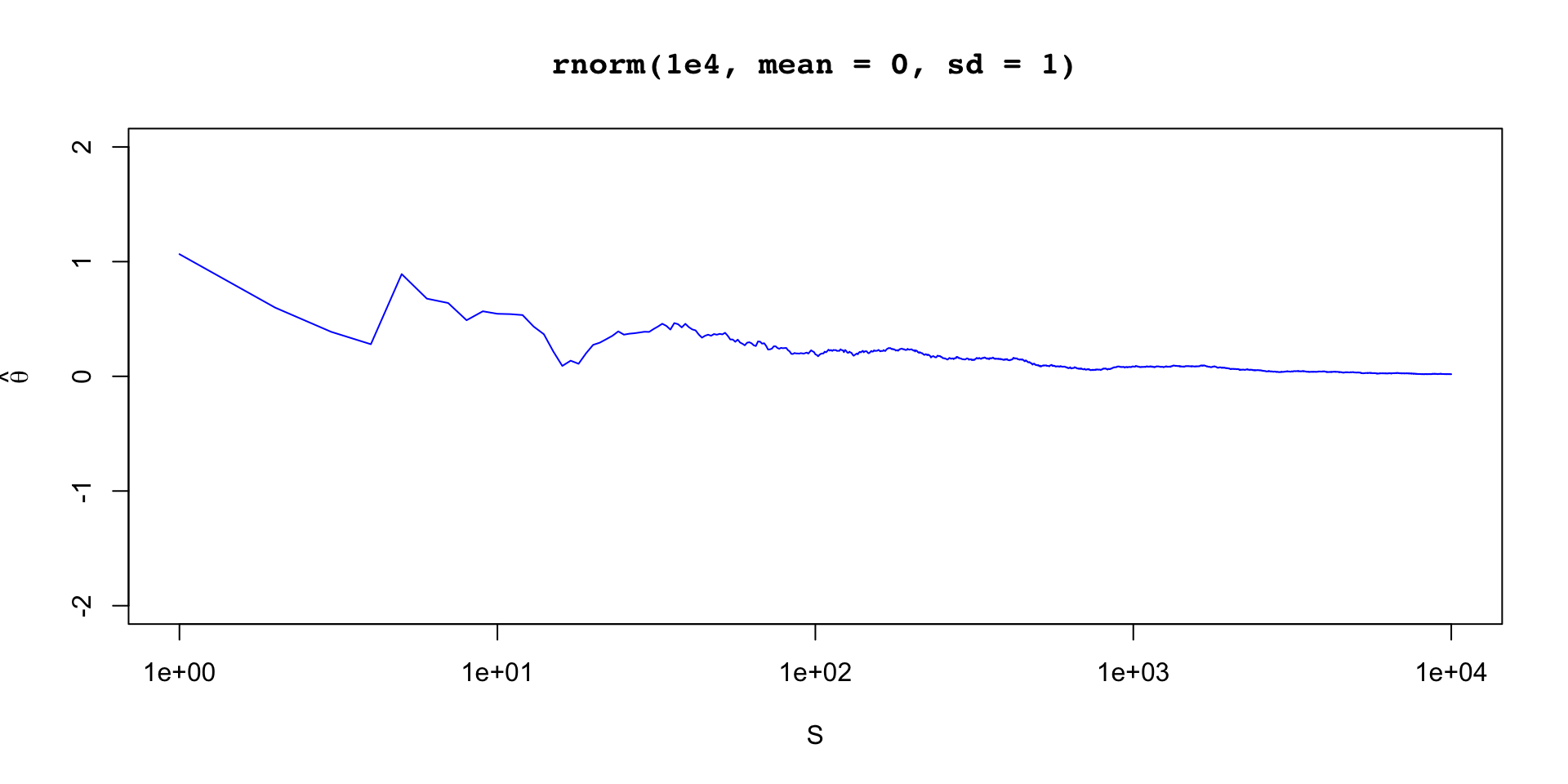
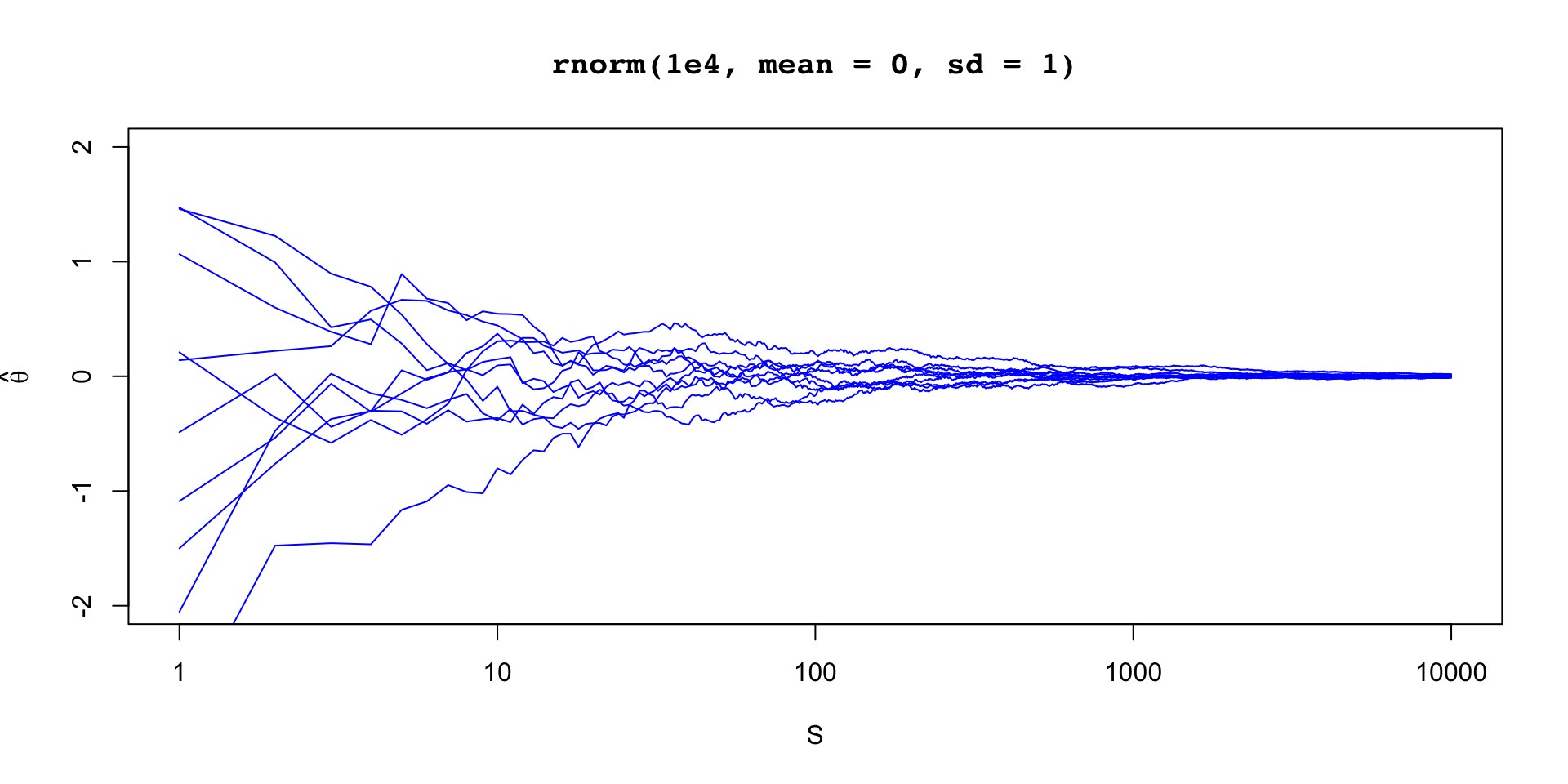
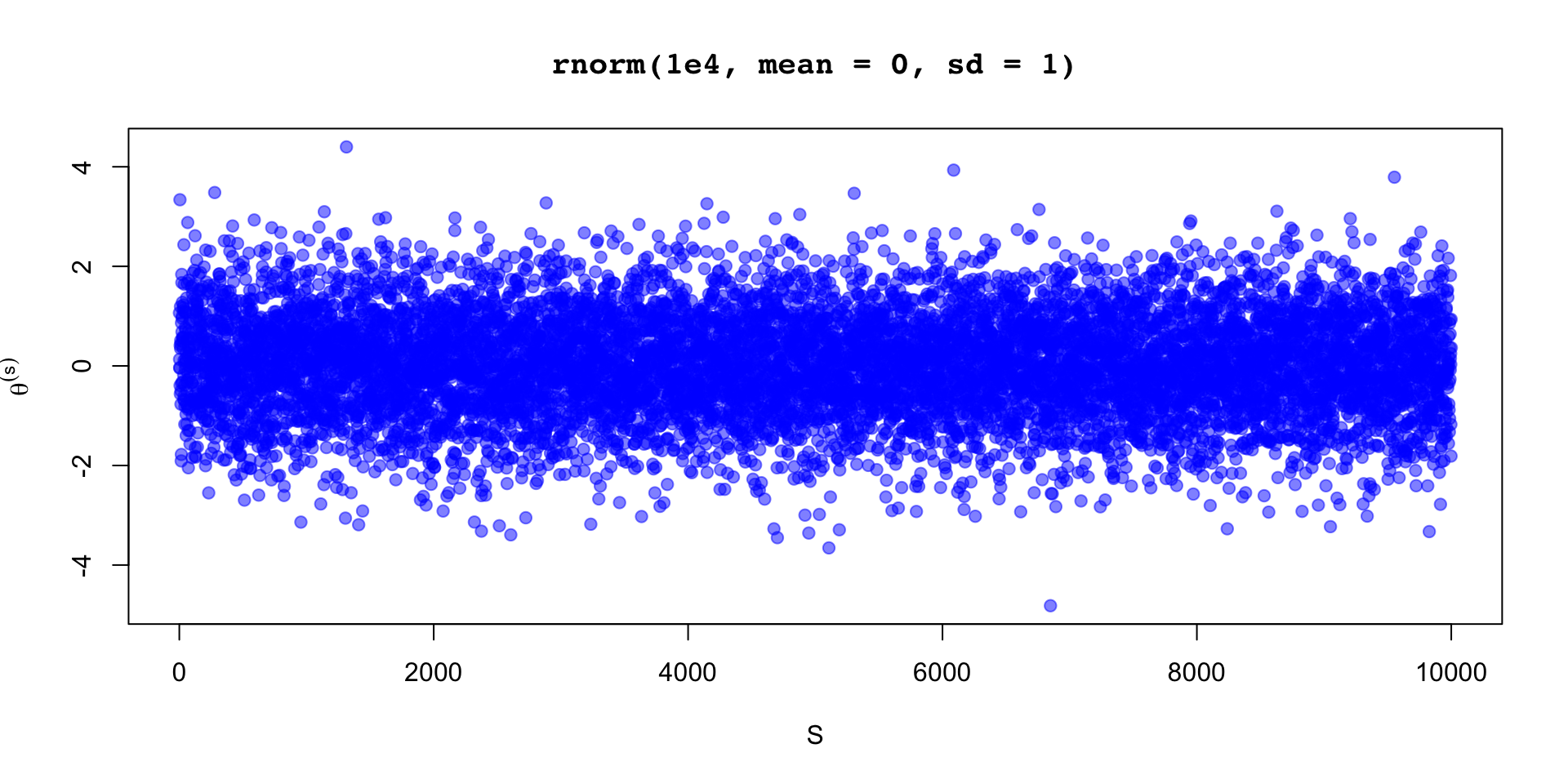
  • Want to find \(\Exp{\theta}\)
  • We have \(\theta^{(s)} \overset{\text{iid}}{\sim} p(\theta)\)
  • Let \(\bar{\theta} = \sum_{s=1}^S \theta^{(s)}\), \(\sigma_\theta^2 = \text{Var}(\theta)\)
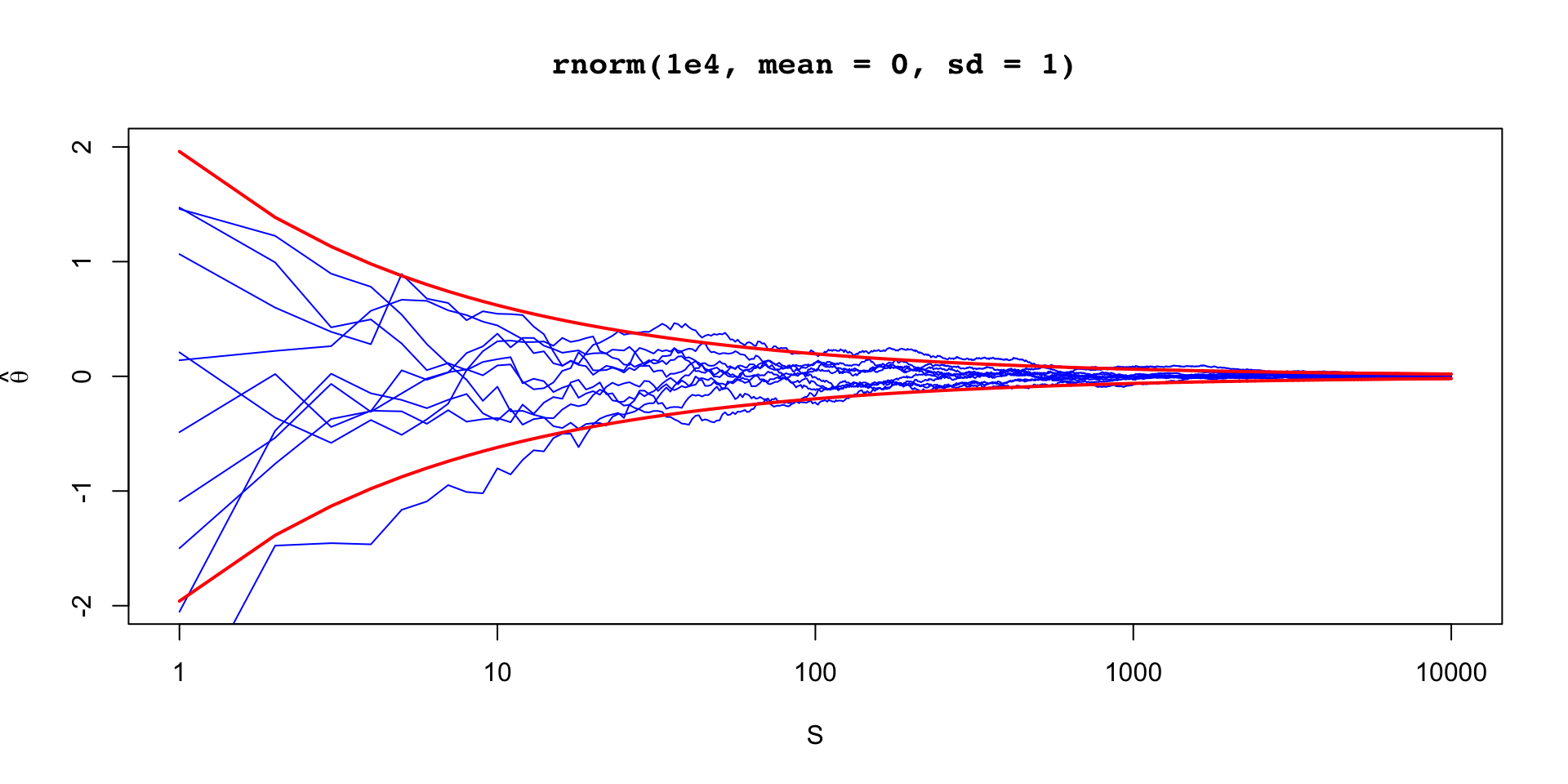
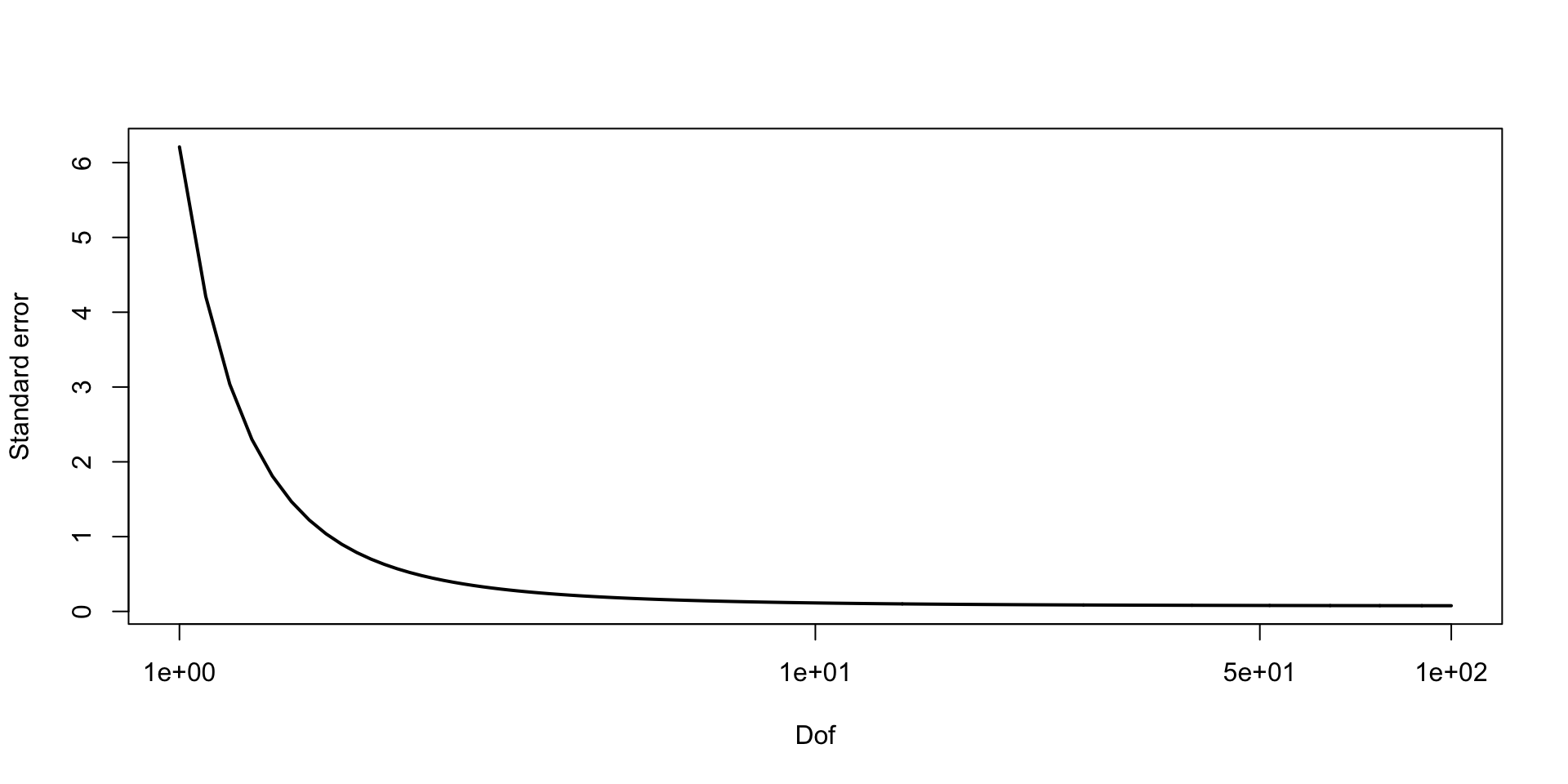
  • We know that \(\sqrt{S}(\bar{\theta} - \Exp{\theta}) \overset{\text{d}}{\to} N(0, \sigma_\theta^2)\)

Benefits and challenges of Monte Carlo over quadrature

  • When variance exists, the variance of our estimate is independent of dimension \(\theta\)

  • \(\text{Var}(\bar{\theta}) = \sigma_\theta^2/S\)

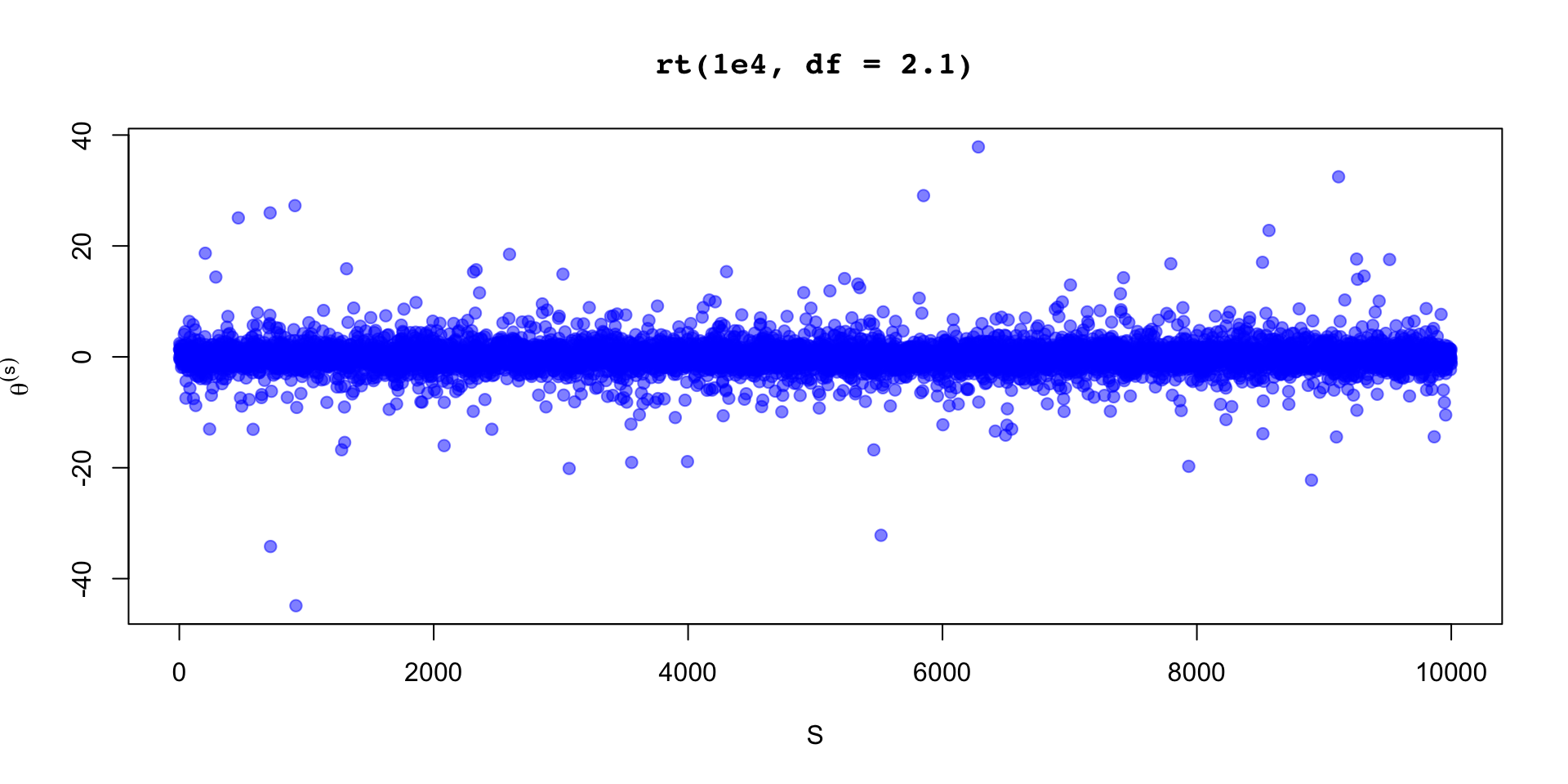
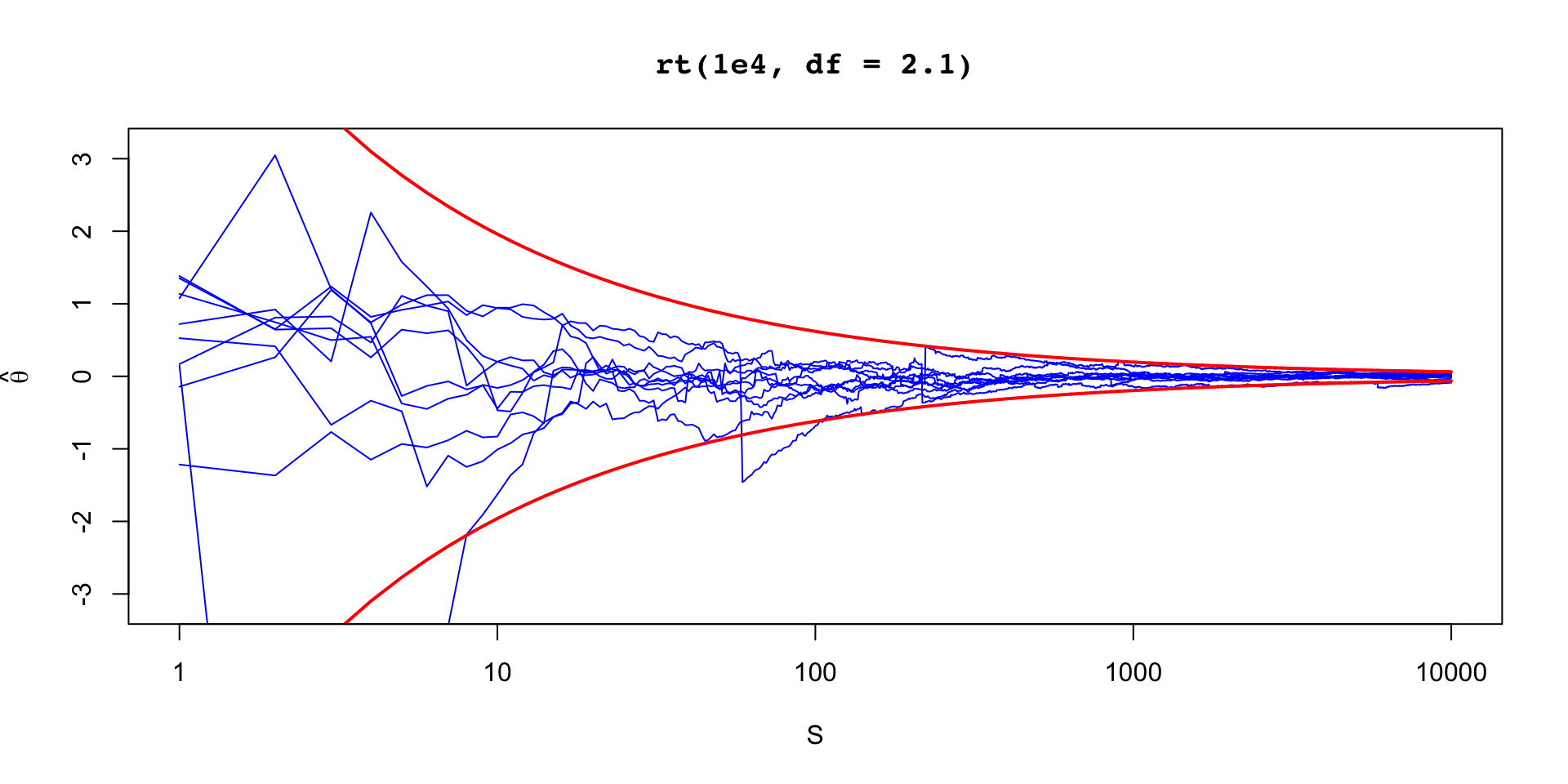
  • … but need to be sure that variance exists

  • When variance doesn’t exist but mean does exist there are other limiting distributions, and may still converge to a normal

  • We have to know how to generate samples from the target distribution

  • We are bound by the variance of the estimand, \(\sigma_\theta^2\)

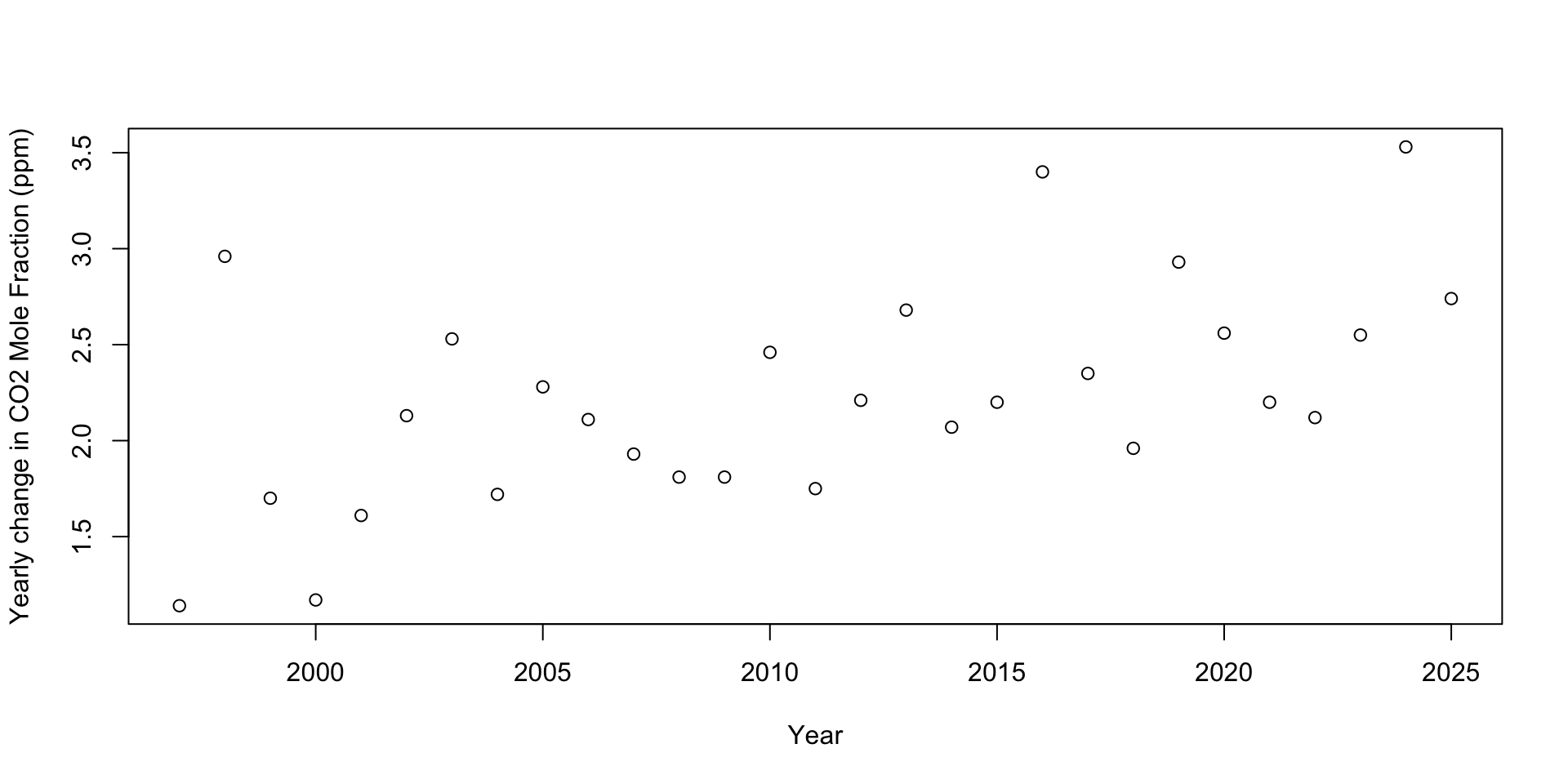
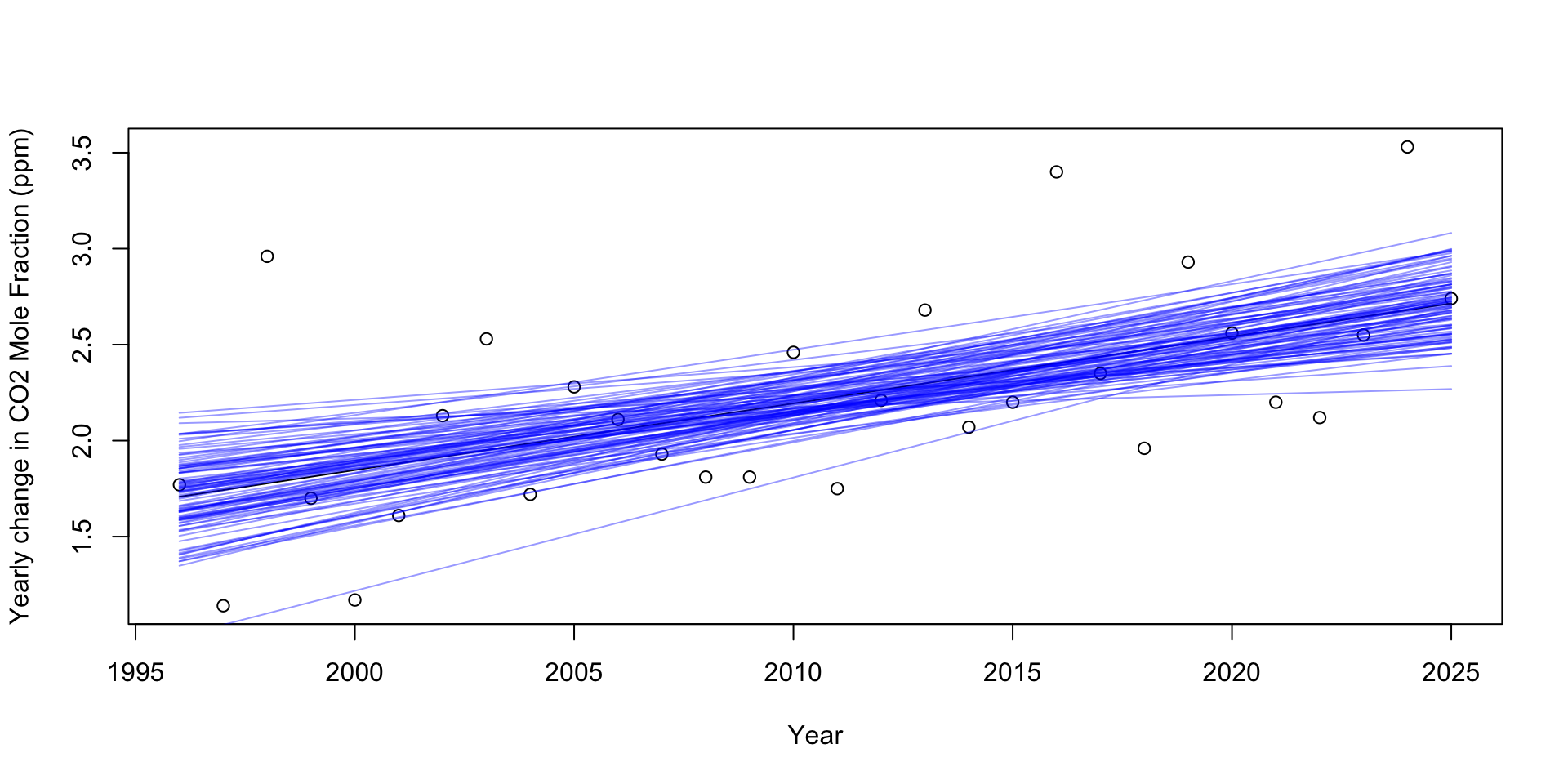
Simple linear regression example: Mauna Loa \(\text{CO}_2\) series

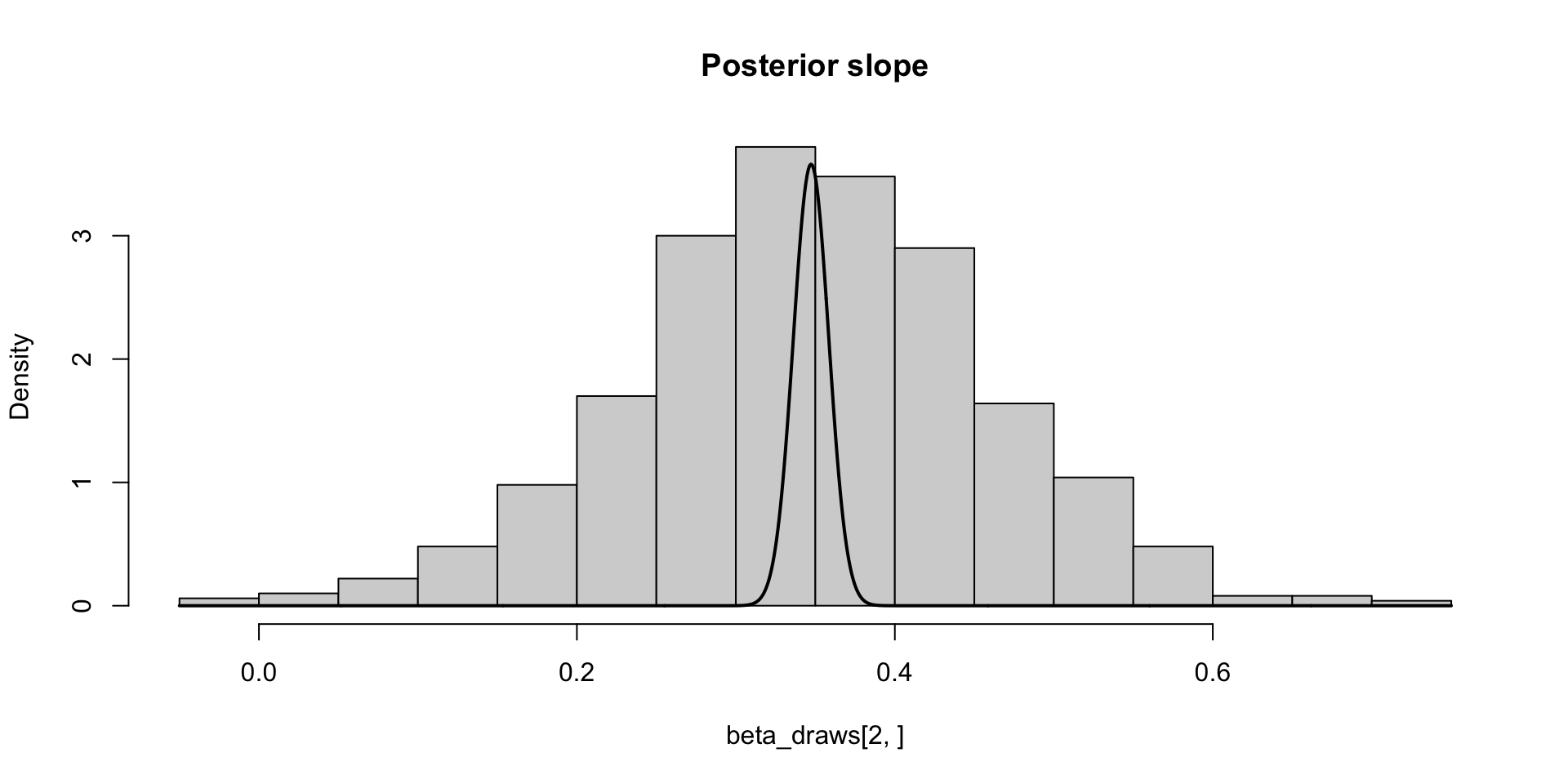
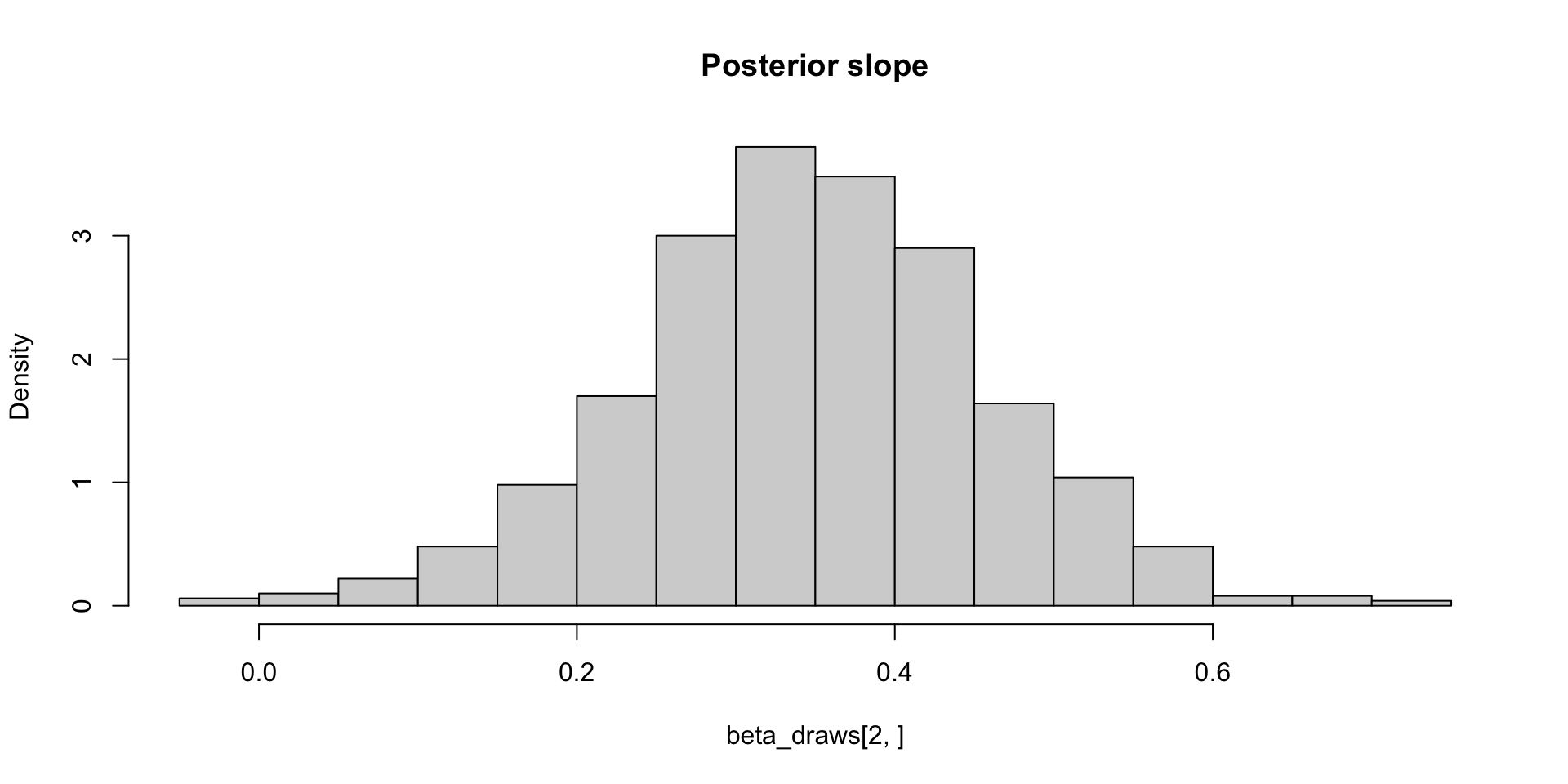
Posterior for slope

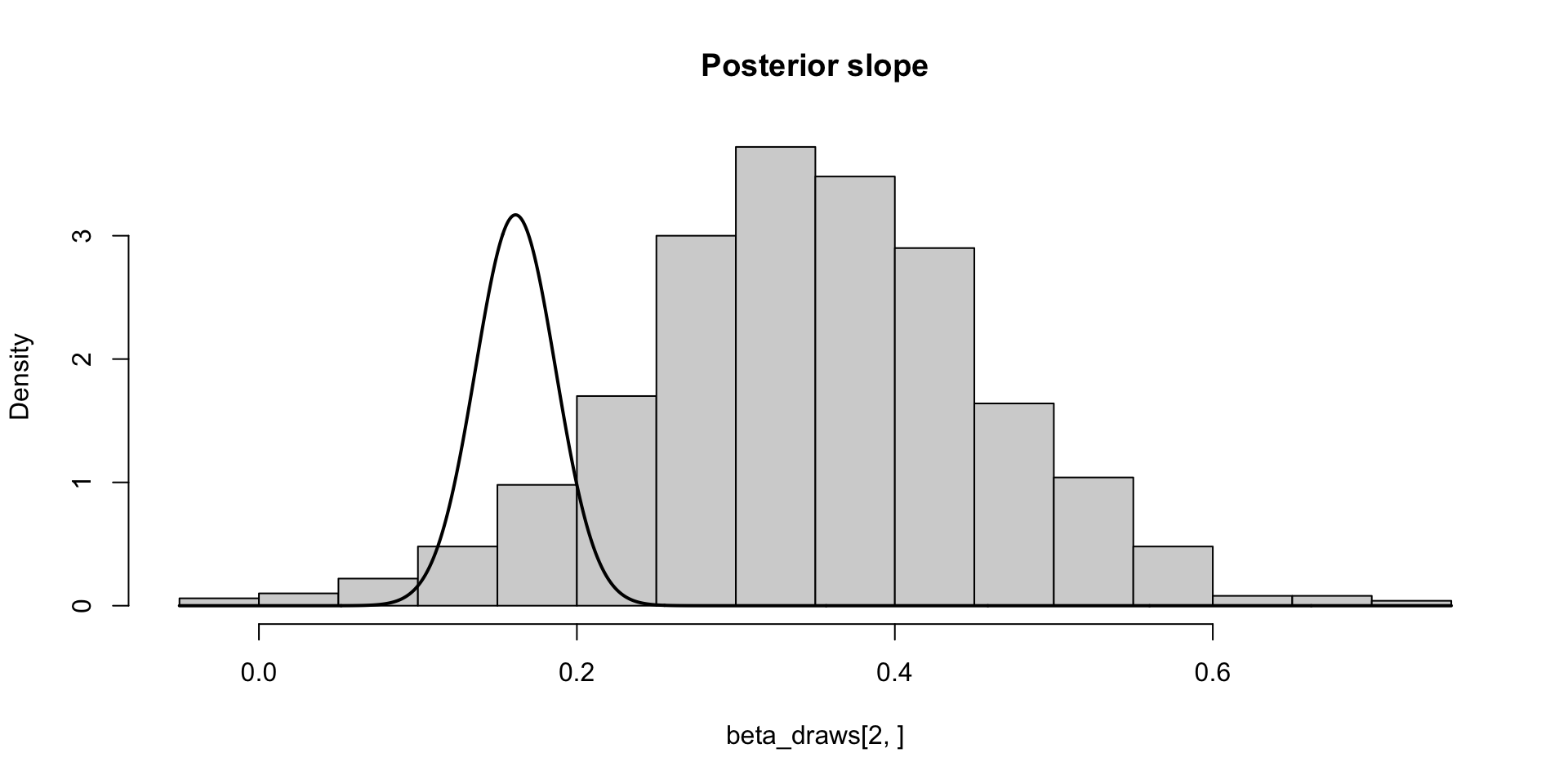
\[ \sigma_\theta \approx 0.12 \implies \text{MCSE}(\hat{\mathbb{E}}[\beta_2 \mid y]) \approx 0.12 / 10 \]
Posterior for slope

\[ \sigma_\theta \approx 0.12 \implies \text{MCSE}(\hat{\mathbb{E}}[\beta_2 \mid y]) \approx 0.12 / 10 \\ P(\Exp{\beta_2 \mid y} \in (0.33, 0.38)) \approx 0.95 \]
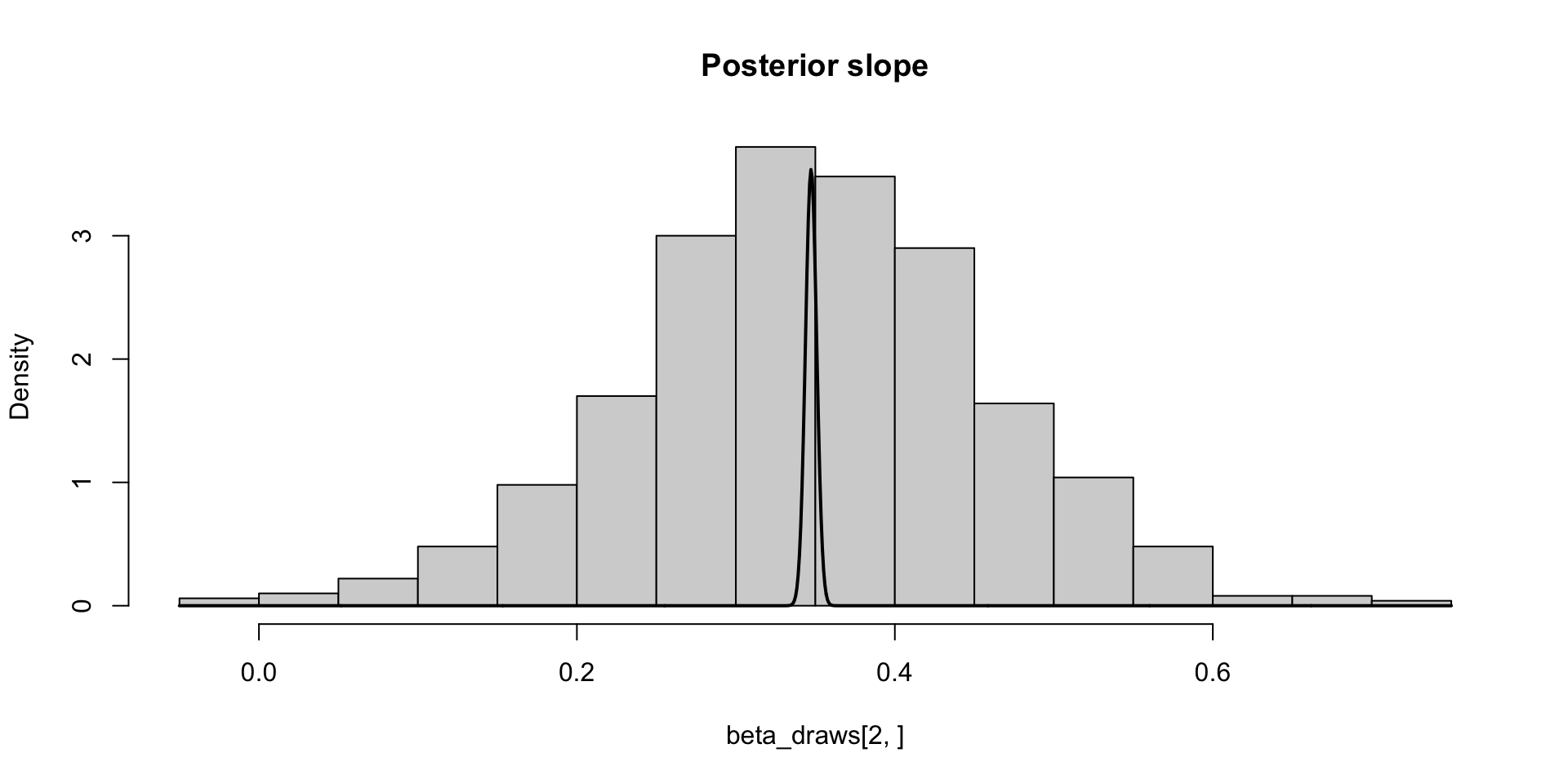
\[ \sigma_\theta \approx 0.12 \implies \text{MCSE}(\hat{\mathbb{E}}[\beta_2 \mid y]) \approx 0.12 / \sqrt{1000} \\ P(\Exp{\beta_2 \mid y} \in (0.35, 0.36)) \approx 0.95 \]

MCSE of a quantile

  • We find the \(p^\mathrm{th}\) quantile by inverting the CDF evaluated at \(p\), \(q = F^{-1}(p)\)

  • We can find the asymptotic standard error of the \(0.05\) quantile as follows:

    • Let \(X_s = \ind{\theta^{(s)} \leq a}\)

    • Let \(\alpha = P(\theta \leq a)\)

    • Then we know that for i.i.d. \(X_i\) such that \(\Exp{X_i} = \alpha\), \(\bar{X} \overset{\text{d}}{\to} \text{N}(\alpha, \alpha (1 - \alpha)/S)\)

    • We want to find \(a\) for which \(P(\theta \leq a) = 0.05\)

    • By Delta method, we know \(g(\bar{X}) \overset{\text{d}}{\to} \text{N}(g(\alpha), \alpha (1 - \alpha) (g'(\alpha))^2 / S)\)

    • In our case \(g(\alpha) \equiv F^{-1}(\alpha) = a\)

    • Note:

\[ \begin{aligned} F(F^{-1}(\alpha)) & = \alpha \\ \frac{d}{d\alpha} F(F^{-1}(\alpha)) & = \frac{d}{d\alpha}\alpha \\ f(F^{-1}(\alpha))\frac{d}{d\alpha}F^{-1}(\alpha) & = 1 \\ f(a)\frac{d}{d\alpha}F^{-1}(\alpha) & = 1 \\ \frac{d}{d\alpha}F^{-1}(\alpha) & = 1/f(a) \\ \end{aligned} \]

What does this mean for us?

\[\hat{F}^{-1}(\alpha) \overset{\text{d}}{\to} N(a, \alpha (1 - \alpha) / f(a)^2 S)\]
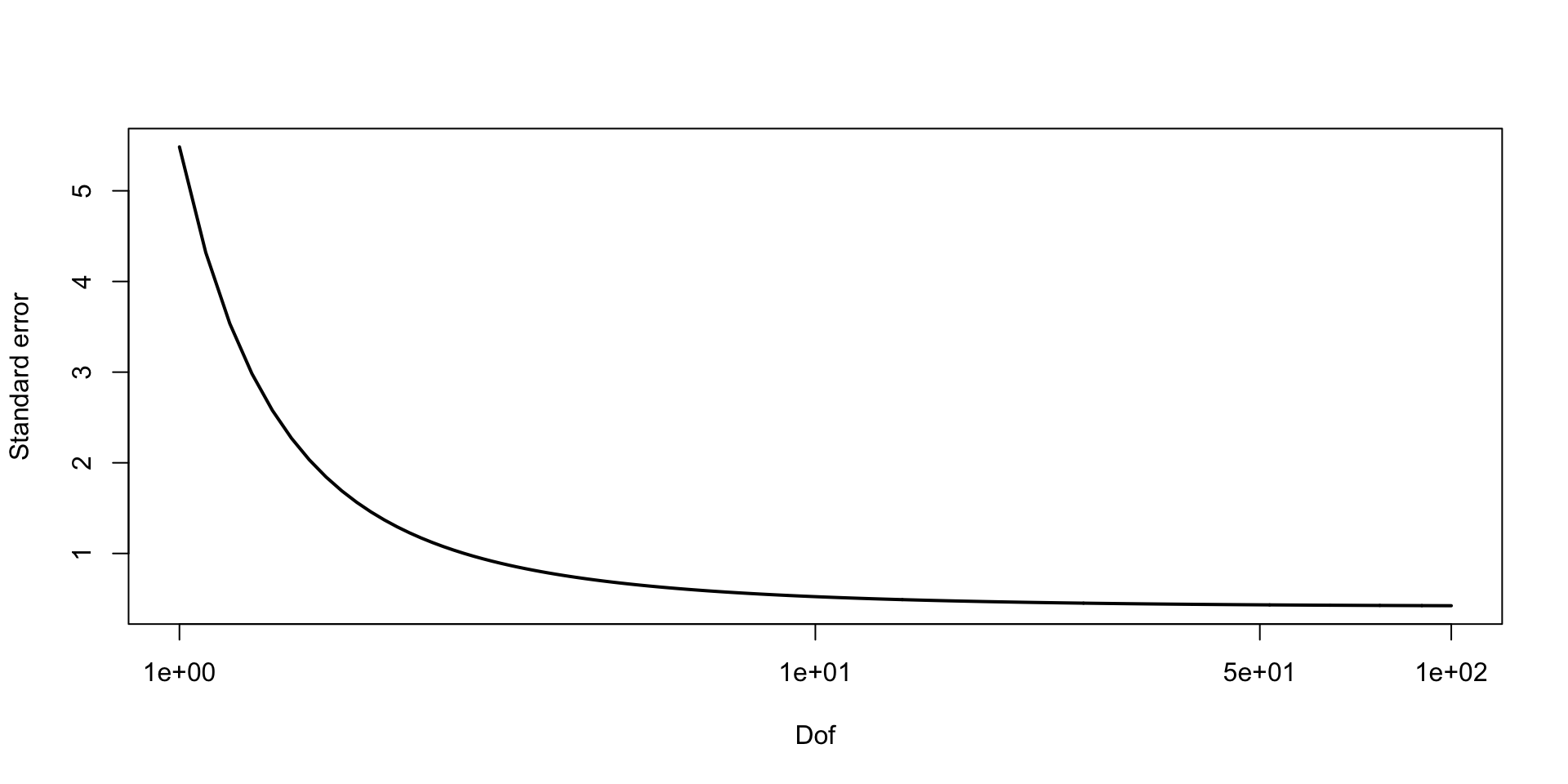
Estimating tail quantiles is harder

\[ \text{MCSE}(\hat{F}_{\beta_2 \mid y}^{-1}(0.05)) \approx \sqrt{0.05 \times 0.95} / 10 f(q) \approx 0.03 \\ P(F_{\beta_2 \mid y}^{-1}(0.05) \in (0.11, 0.21)) \approx 0.95 \]
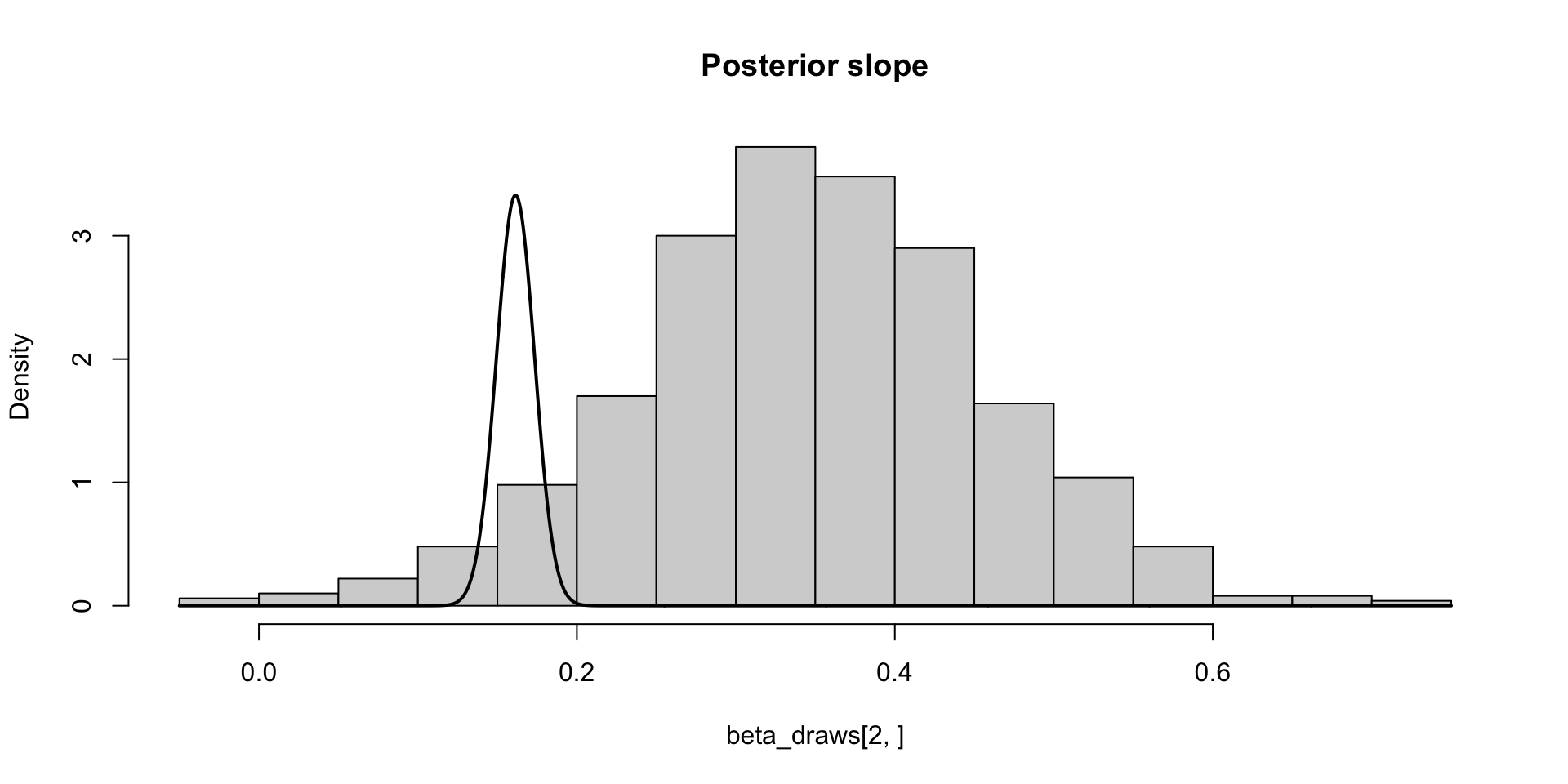
\[ \text{MCSE}(\hat{F}_{\beta_2 \mid y}^{-1}(0.05)) \approx \sqrt{0.05 \times 0.95 / 1000 f(q)} \approx 0.01 \\ P(F_{\beta_2 \mid y}^{-1}(0.05) \in (0.14, 0.18)) \approx 0.95 \]
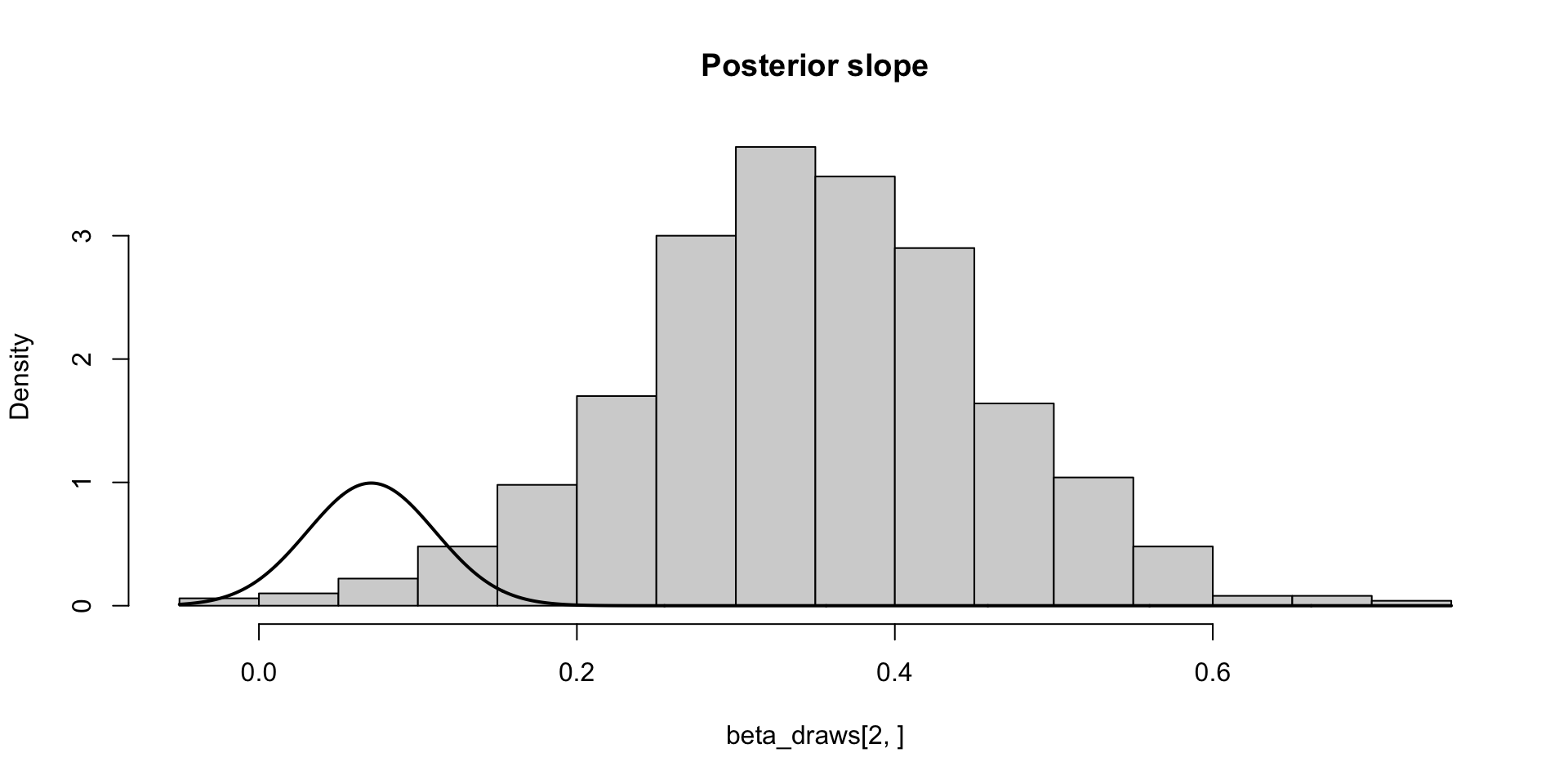
Estimating tail quantiles is harder

\[ \text{MCSE}(\hat{F}_{\beta_2 \mid y}^{-1}(0.05)) \approx \sqrt{0.01 \times 0.99} / 10 f(q) \approx 0.04\\ P(F_{\beta_2 \mid y}^{-1}(0.01) \in (-0.01, 0.15)) \approx 0.95 \]
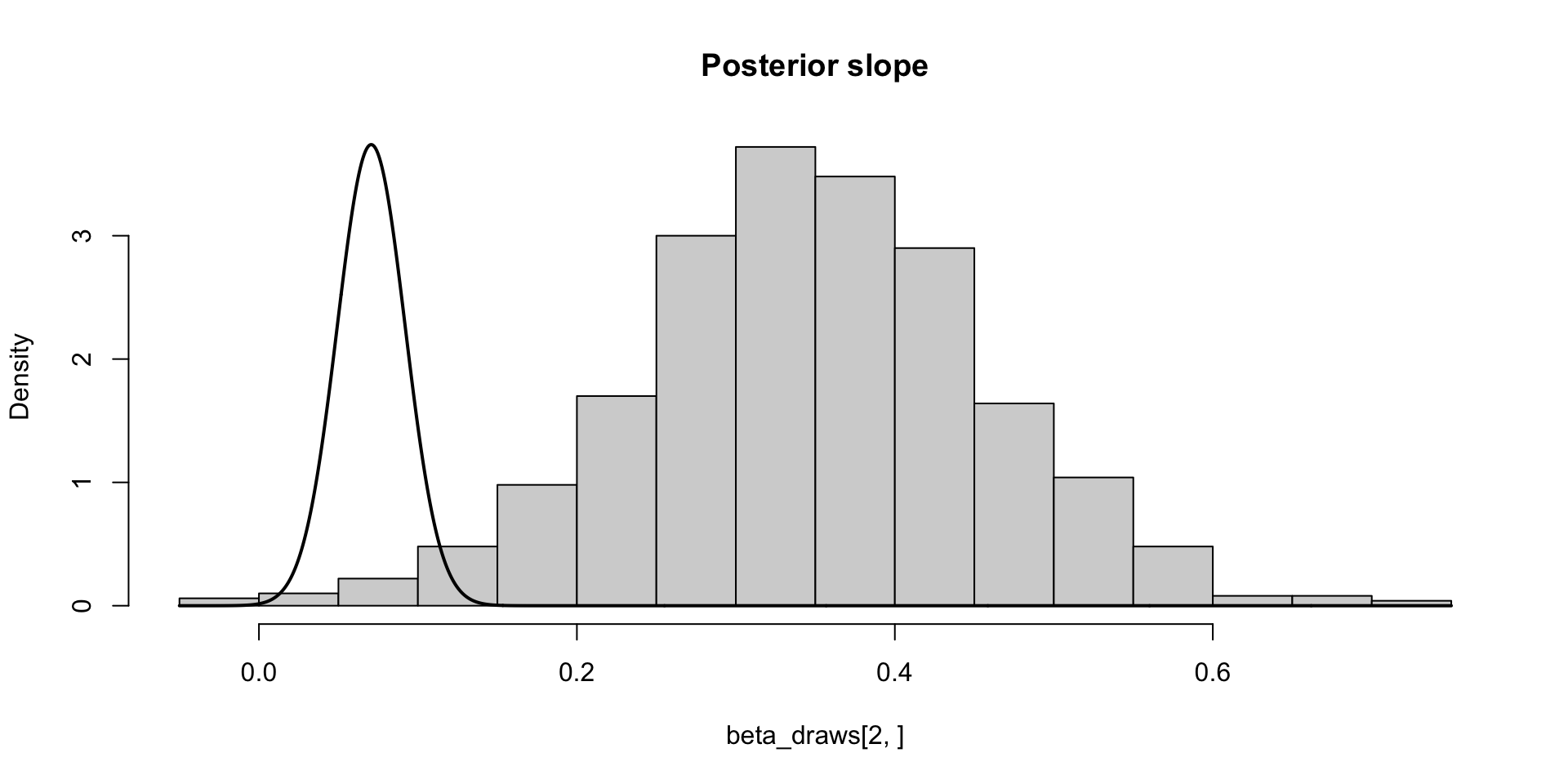
\[ \text{MCSE}(\hat{F}_{\beta_2 \mid y}^{-1}(0.05)) \approx \sqrt{0.01 \times 0.99 / 1000f(q)} \approx 0.02 \\ P(F_{\beta_2 \mid y}^{-1}(0.01) \in (0.03, 0.11)) \approx 0.95 \]

Recap

  • Two types of uncertainty we (typically) need to deal with when doing inference

    • Statistical uncertainty: quantified by sampling or posterior variance, credible/confidence intervals

      • Frequentist interpretation: Uncertainty in our estimates driven by the fact that our data is one of many samples of data we could have observed, quantified via variance of sampling distributions, confidence intervals

      • Bayesian interpretation: Uncertainty in our estimates driven by the fact that our given data set could have been generated by one of many parameter values, quantified via posterior variance, and credible intervals (aka posterior intervals)

    • Monte Carlo uncertainty: Uncertainty given by the fact that we have finite number of samples from a distribution to compute a quantity of interest

  • Both types of uncertainty exist when we do Bayesian statistics

  • Monte Carlo uncertainty enters into how we quantify posterior uncertainty when we have samples from the posterior

  • We quantify Monte Carlo uncertainty with the CLT

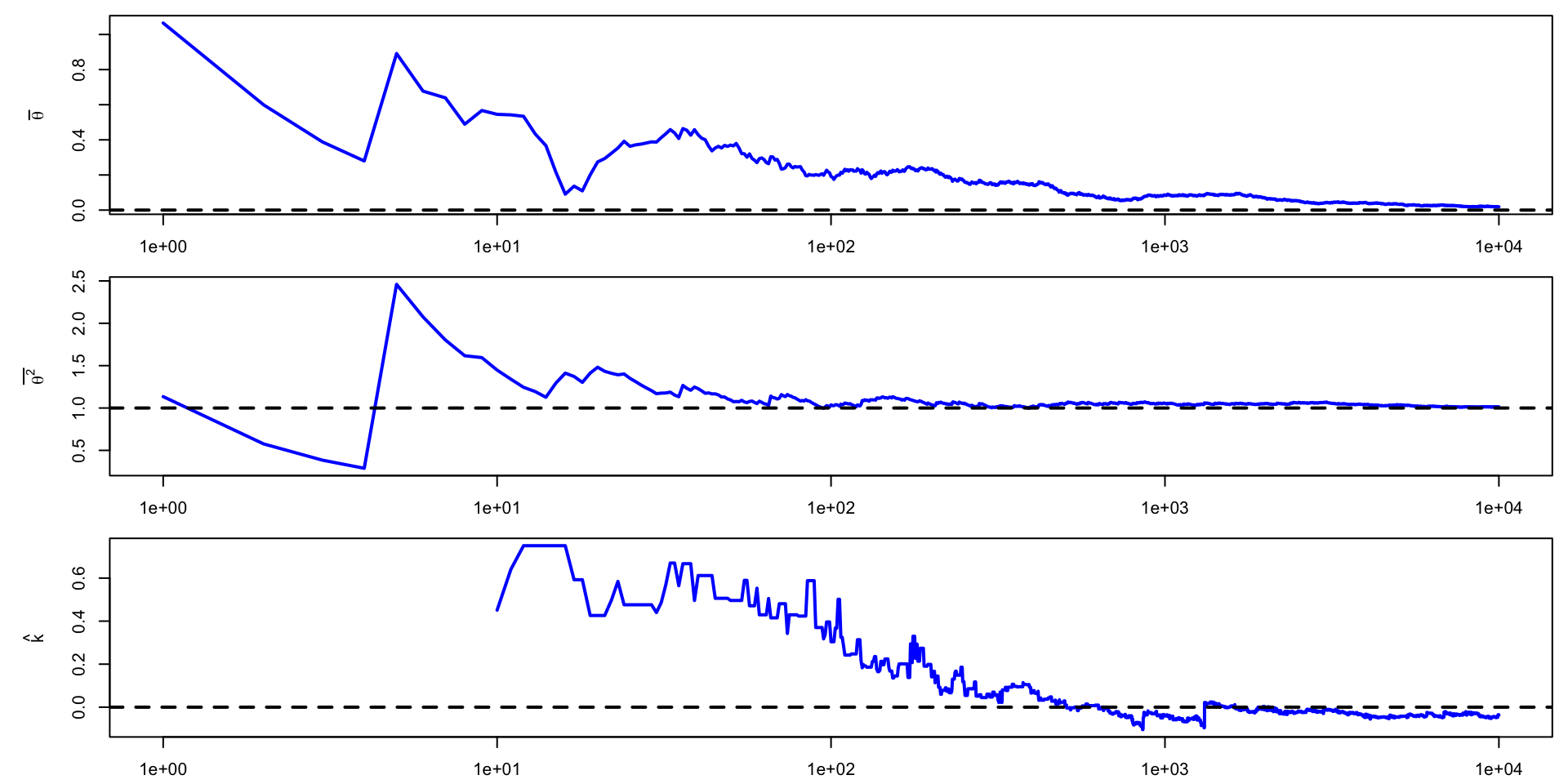
Checks for how many moments exist

  • To easily apply the CLT, we need to know if first and second moments exist[^1] [^1] We don’t need a mean or variance for the CLT to hold, but if the first two moments exist we can apply the CLT

  • If we have a set samples \(\{\theta^{(s)}, s = 1, \dots, S\}\) from \(p(\theta \mid y)\), is there a way to determine if \(\Exp{\theta^k \mid y}\) exists?

  • The answer lies in characterizing the tails of the distribution of \(\theta \mid y\)

    • We know that \(\Exp{X} = \int x f(x) dx\)

    • Let’s just focus on \(X > 0\). We can write, for large, finite \(K\)

\[ \int_0^\infty x f(x) = \int_{x < K} x f(x) dx + \int_{K}^{\infty} x f(x) dx \]

  • If we can find an upper bound on the \(f(x)\) for \(x > K\) that is \(O(x^{-(2 + \delta)})\) for some \(\delta > 0\), the integral will be finite

\[ \int_0^\infty x f(x) \leq K P(X < K) + \int_{K}^{\infty} x^{-(1 + \delta)} dx < \infty \]

  • Thus we need to quantify the tail behavior of our samples

Generalized Pareto distribution for tails

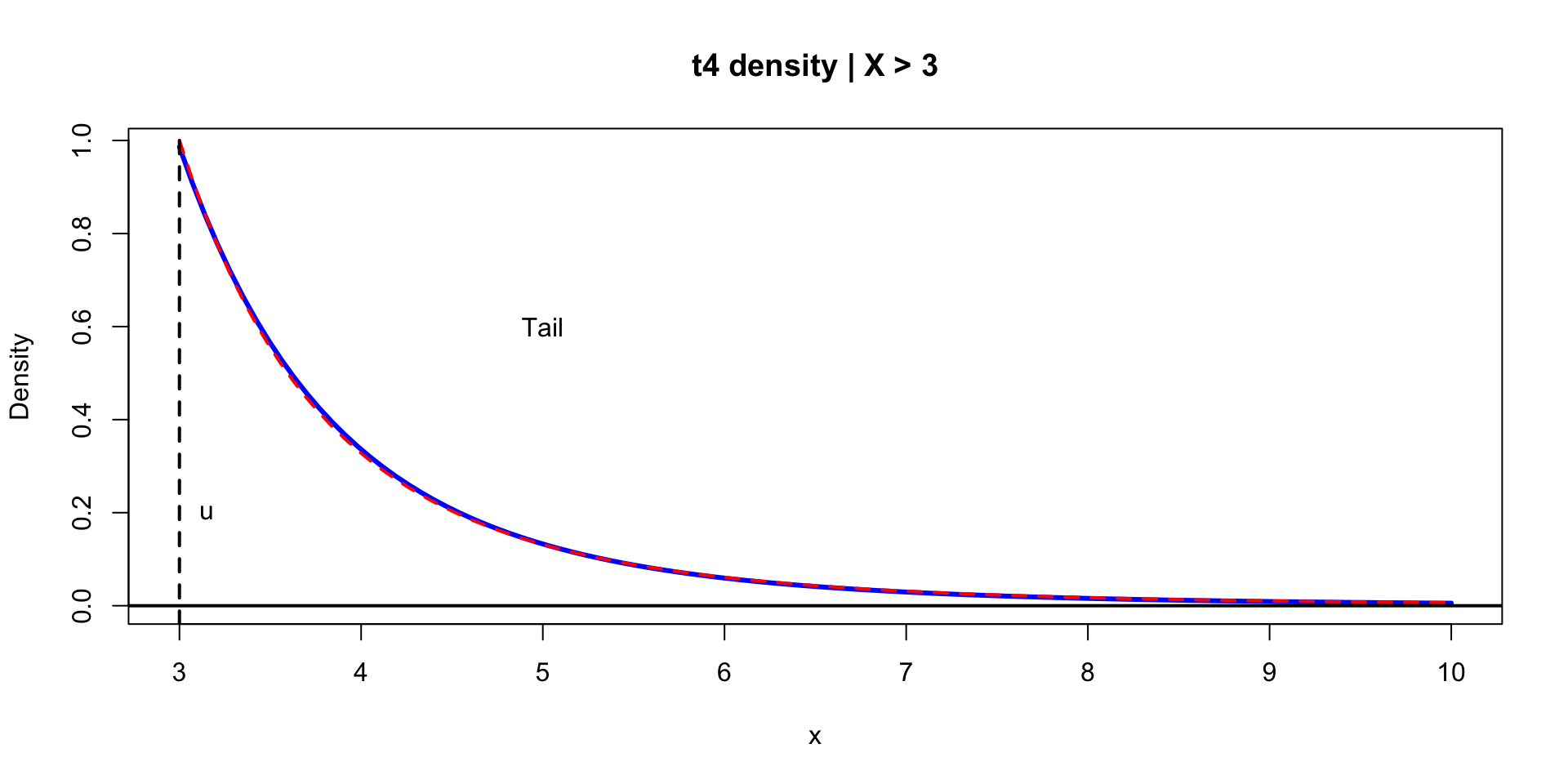
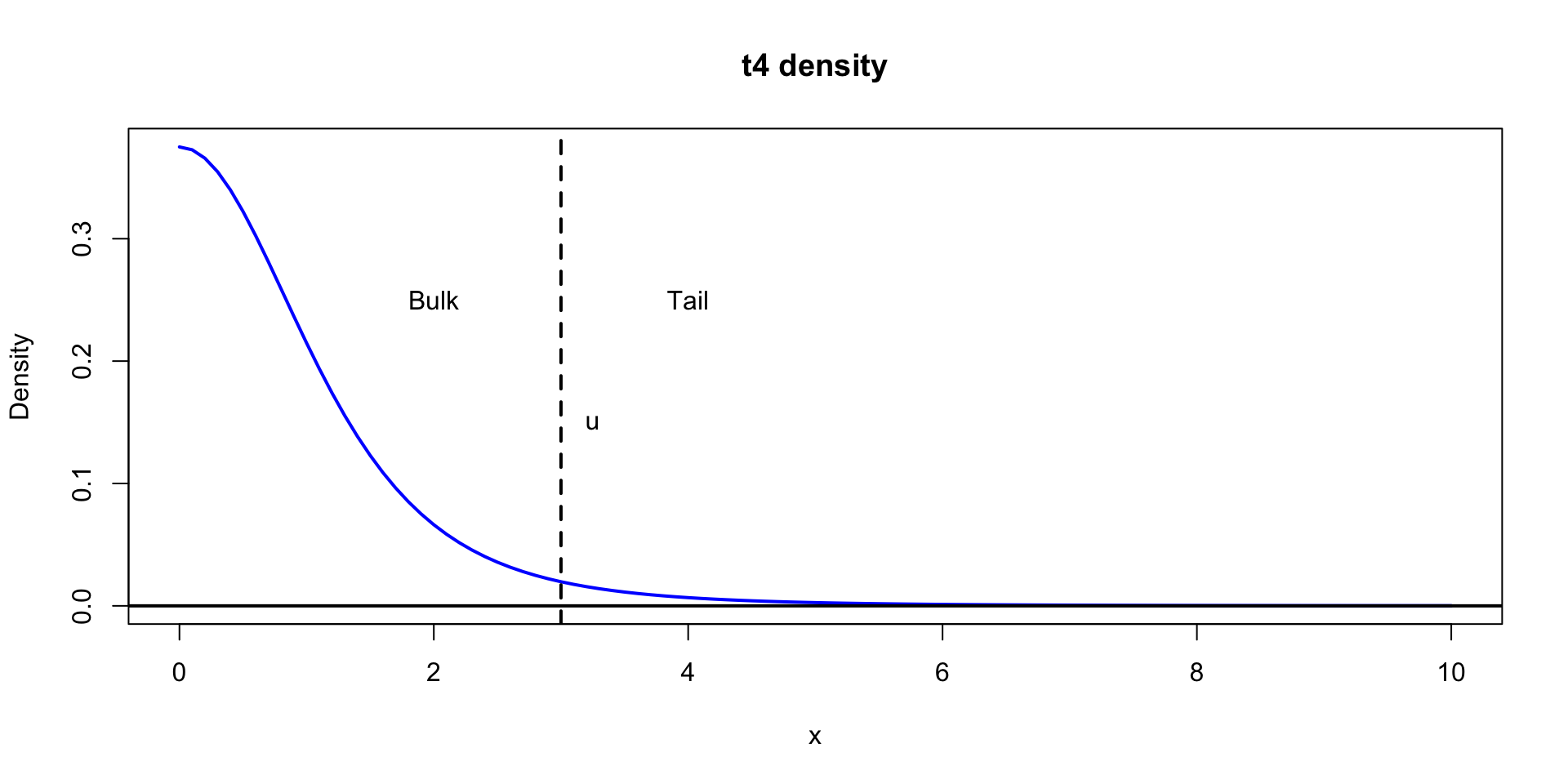
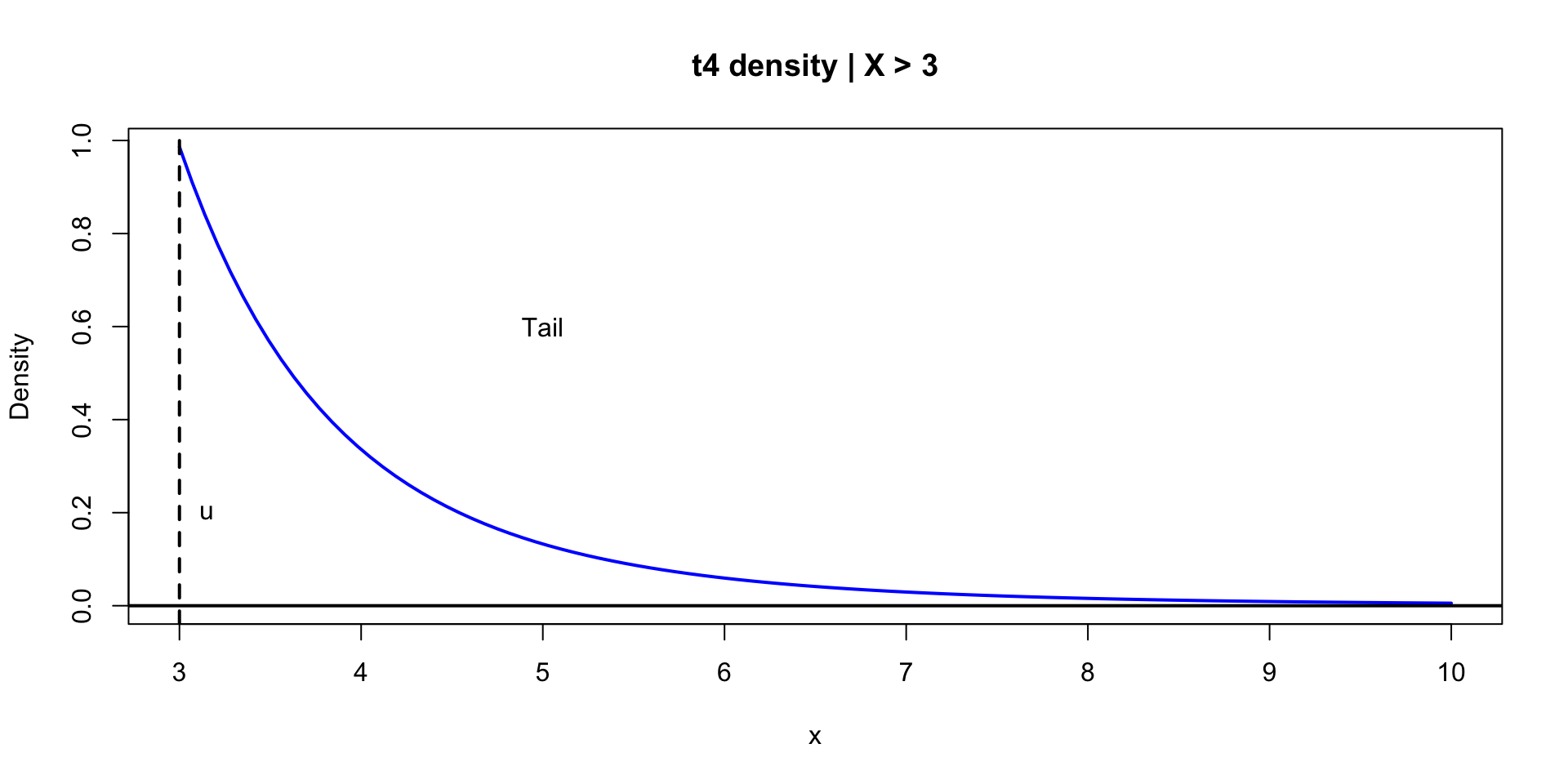
  • Pickands (1975) shows that for a large class of random variables \(X\) the distribution of \(X \mid X > u\) is well approximated by a Generalized Pareto distribution (GPD), with \(1/k\) moments

\[ p(y \mid u, \sigma, k) = \begin{cases} \frac{1}{\sigma}(1 + k \lp \frac{y - u}{\sigma} \rp)^{-(1 + 1/k)}, & k \neq 0 \\ \frac{1}{\sigma}\exp\lp \frac{y - u}{\sigma} \rp), & k = 0 \end{cases} \]
How to fit a GPD

library(posterior)

theta <- rnorm(1e3)
pareto_khat(theta)
[1] -0.05810098

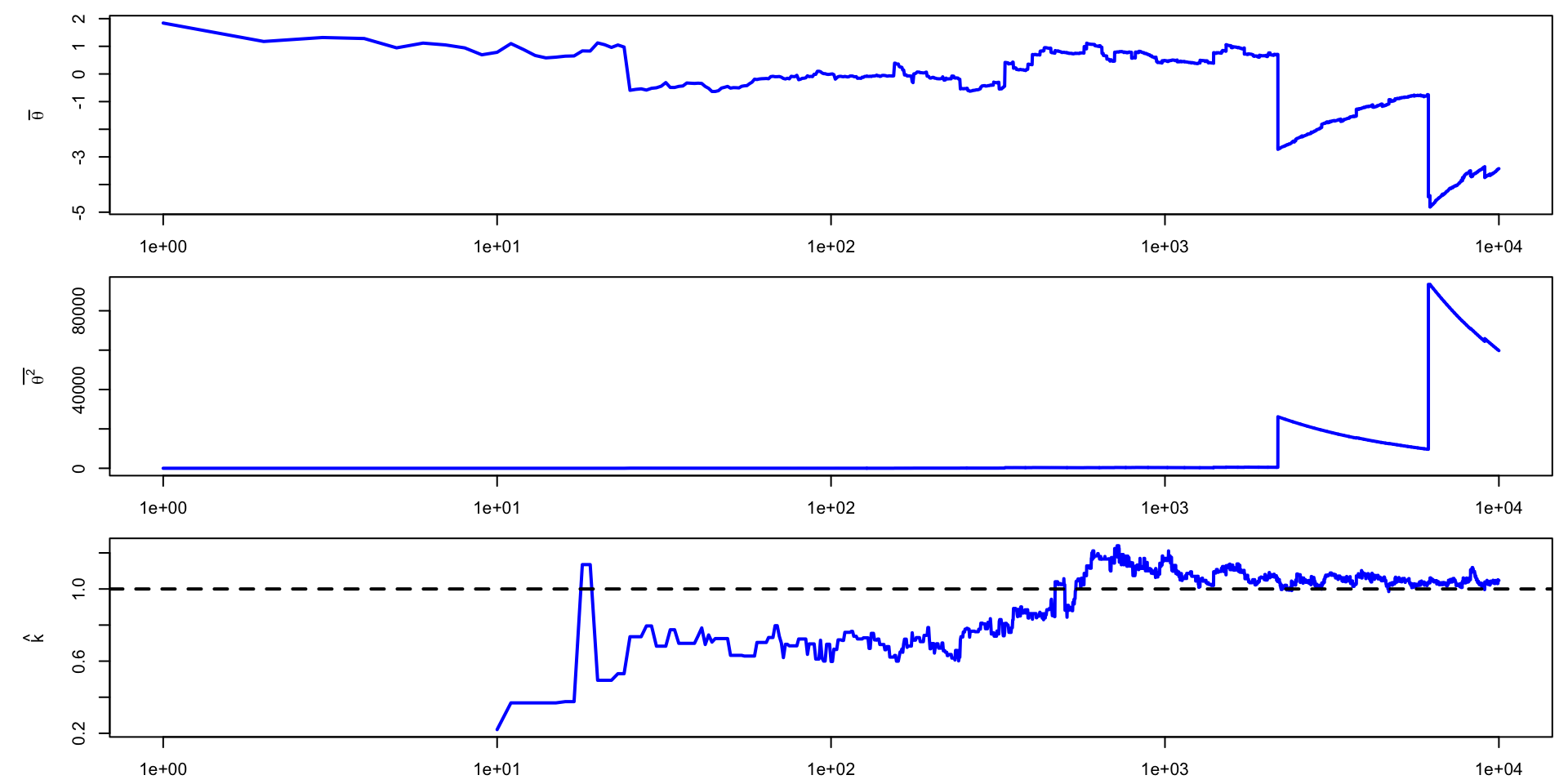
Examples

\(\theta \sim \text{Normal}(0,1)\)

\(\theta \sim \text{t}(4, 0,1)\)
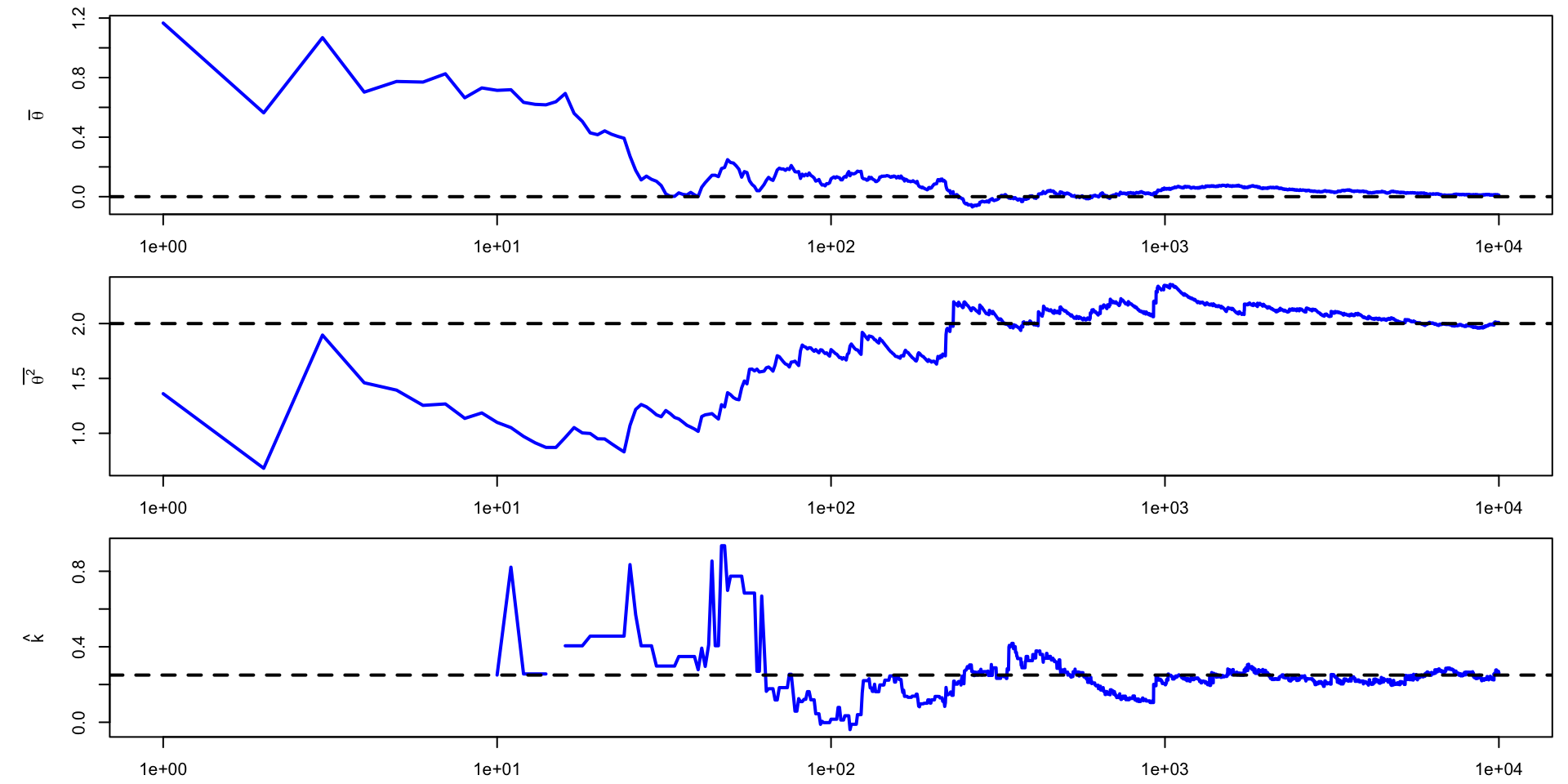
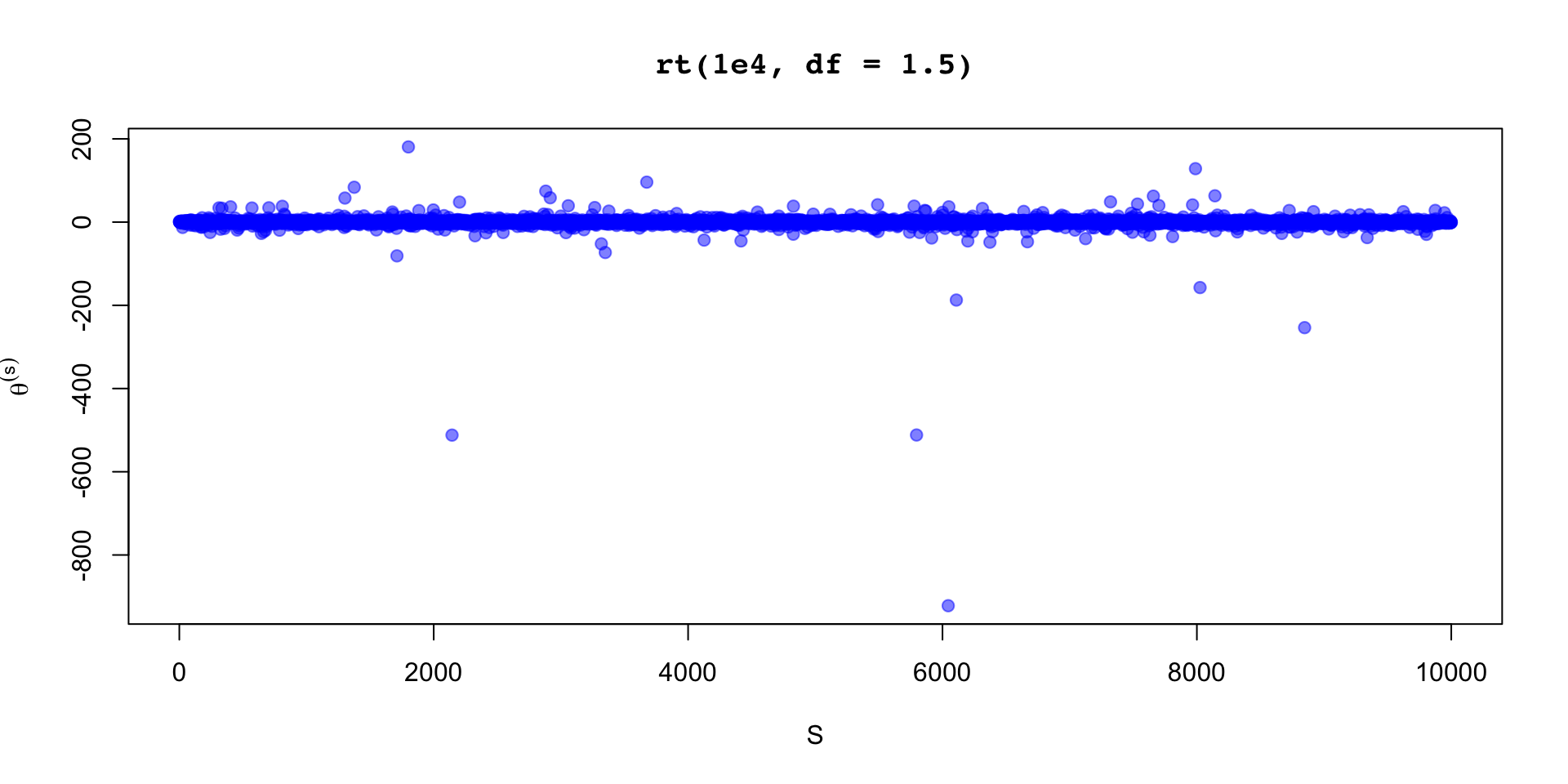
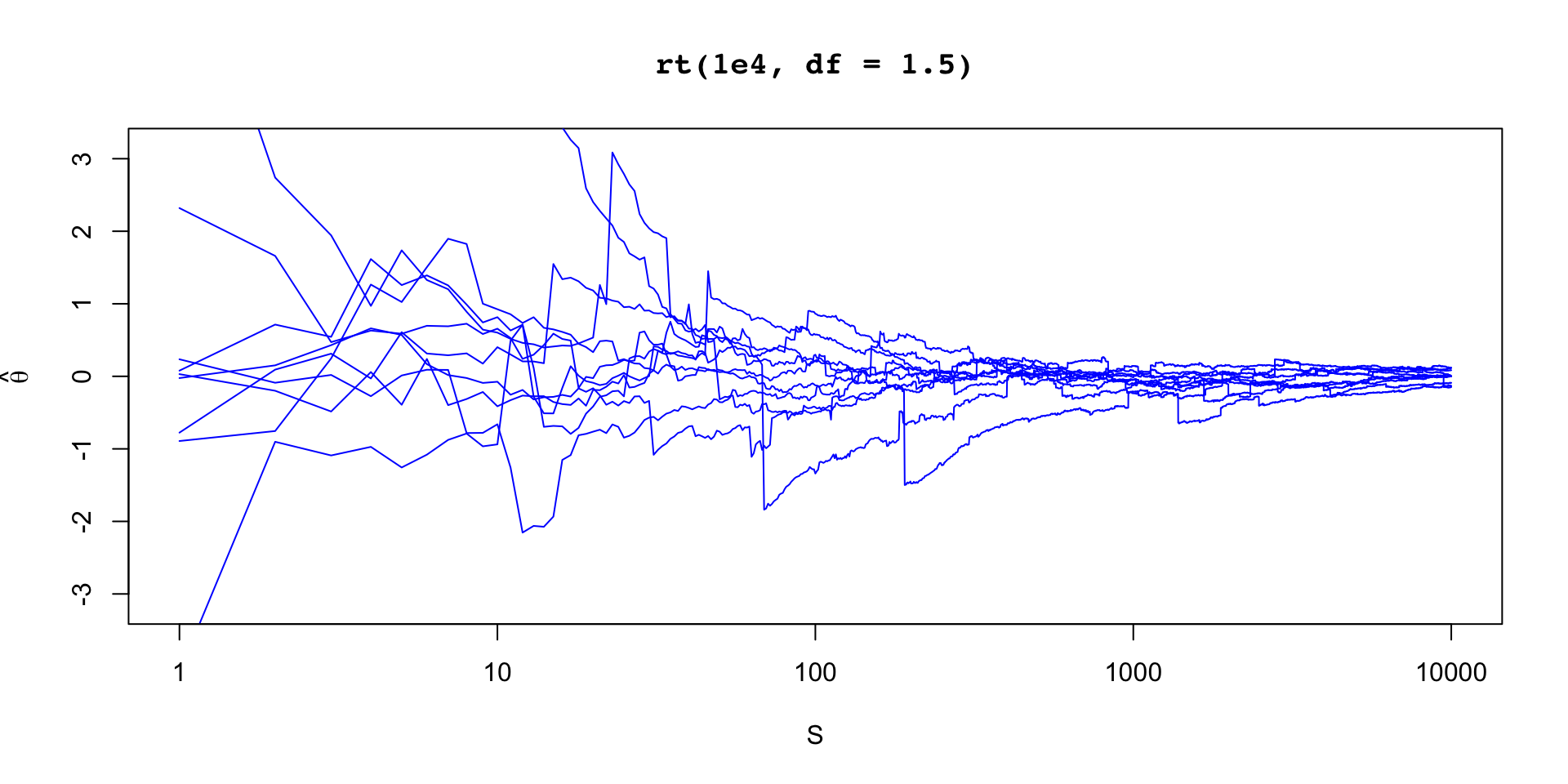
\(\theta \sim \text{t}(2, 0,1)\)
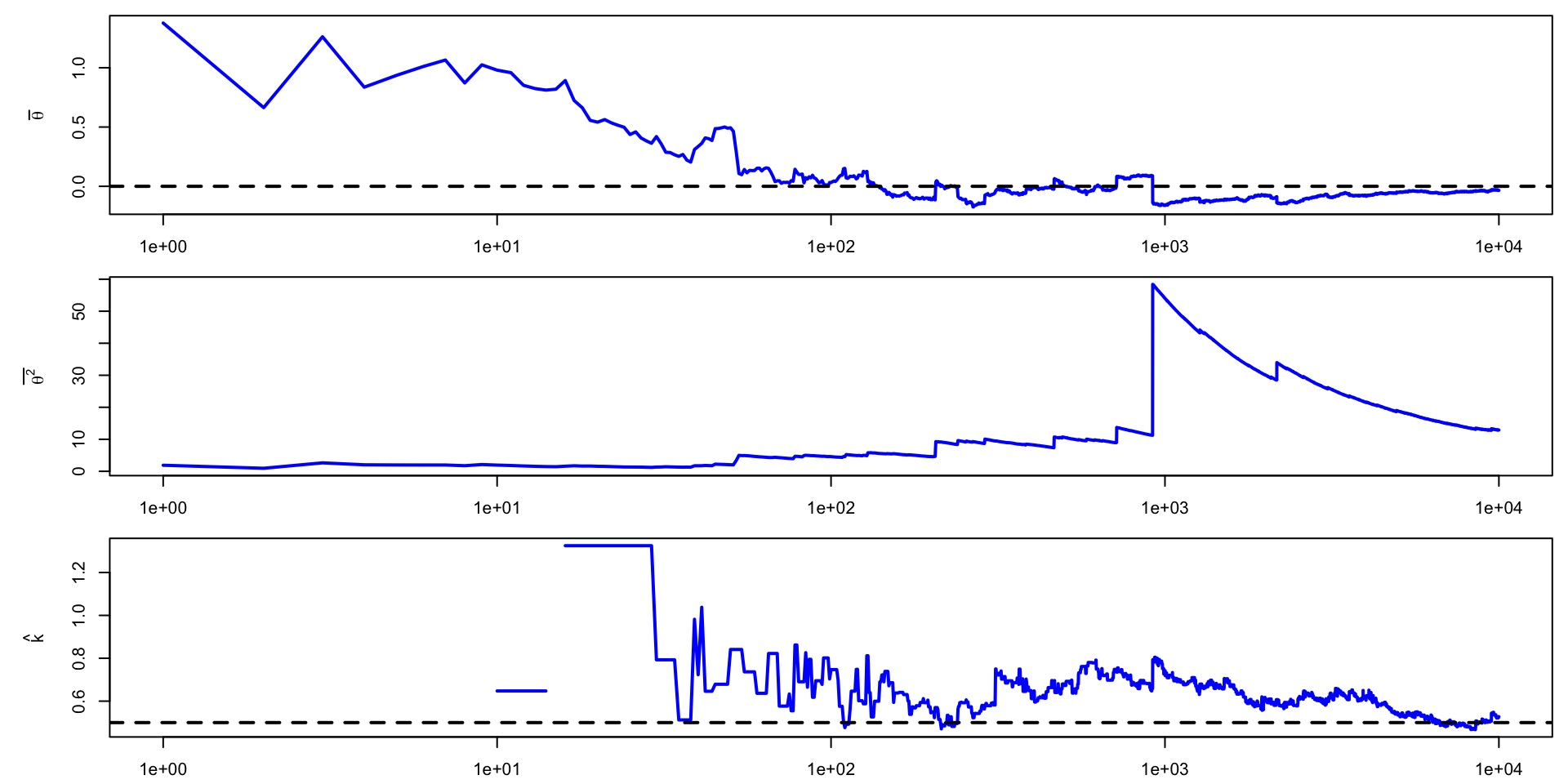
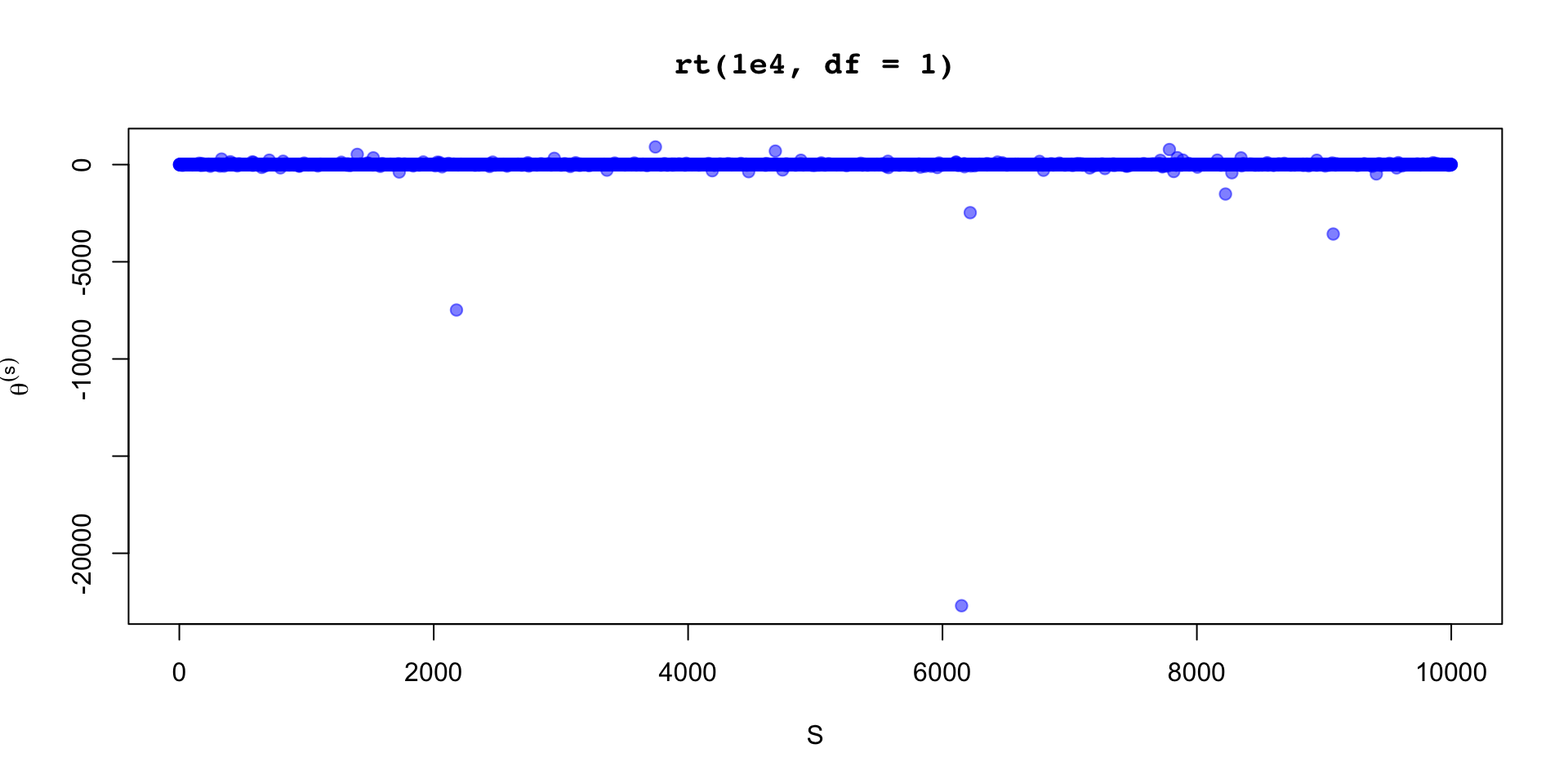
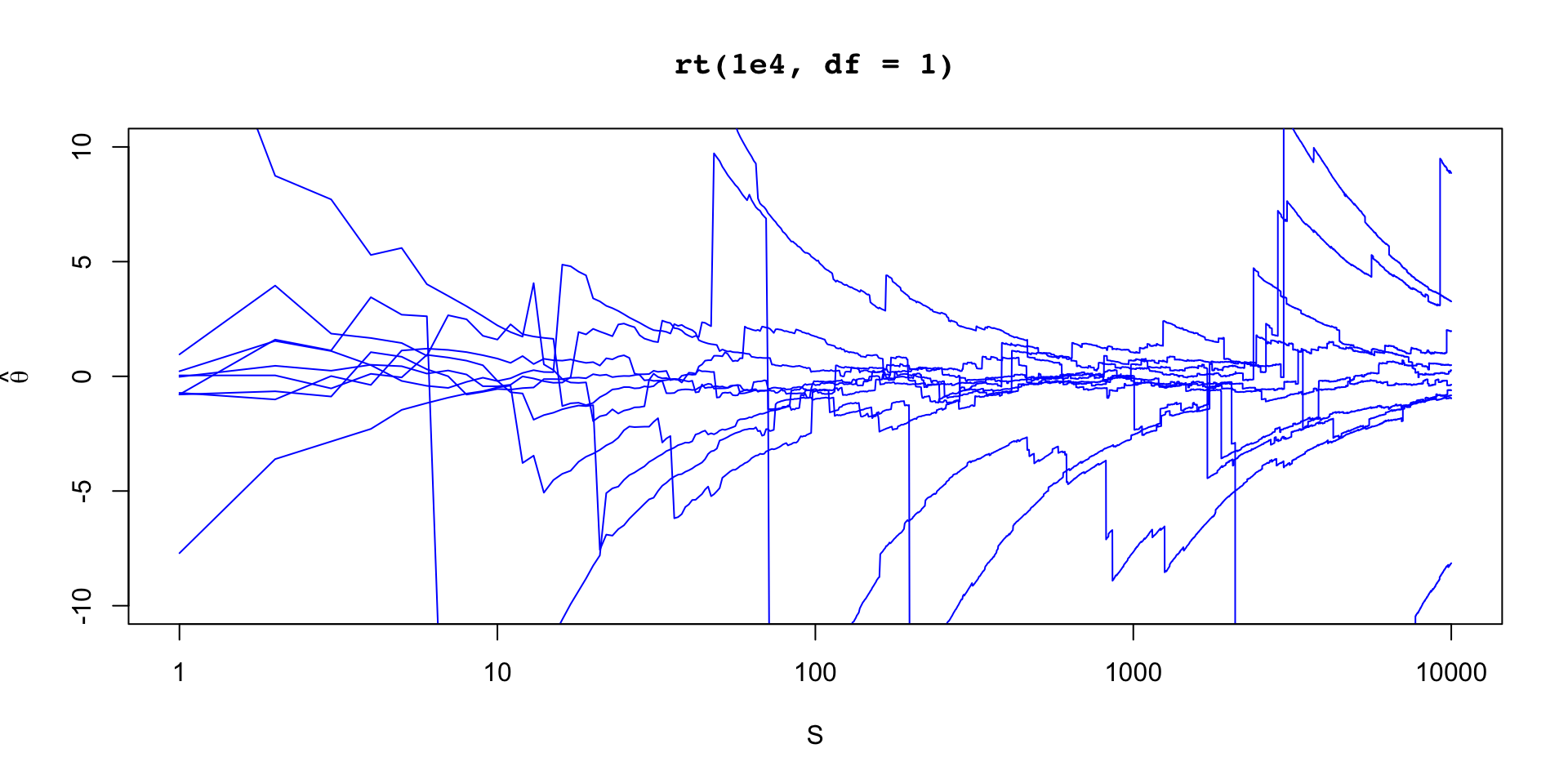
\(\theta \sim \text{t}(1, 0,1)\)
Using Pareto-k in posterior parckage

df <- 
  data.frame(
    norm = rnorm(1e4),
    rt4 = rt(1e4, df = 4),
    rt2 = rt(1e4, df = 2),
    rt1 = rt(1e4, df = 1)
  )

df |> 
  posterior::summarise_draws(mean, sd, mcse_mean, pareto_khat,
                             .num_args = list(sigfig = 2, notation = "dec")) 
# A tibble: 4 × 5
  variable     mean    sd mcse_mean pareto_khat
  <chr>       <dbl> <dbl>     <dbl>       <dbl>
1 norm      0.014     1.0     0.010      -0.089
2 rt4       0.0043    1.4     0.014       0.30 
3 rt2       0.00038   3.0     0.030       0.50 
4 rt1      -0.37    104.      1.0         0.94 

Using pareto-k in practice

  • If \(\hat{k}\) is large, use a quantile to summarize the posterior instead of a moment

  • There is, of course, variance in \(\hat{k}\) estimation because of finite sample size

    • If \(\hat{k}\) is nearly \(0.5\) increase samples to get more precision in \(\hat{k}\) estimate
  • For \(\hat{k} < 0.7\) one can use smoothing to increase the efficiency of the mean estimate

    • Essentially use the order statistics from a fitted pareto distribution in place of draws from the tail to stabilize estiamtes of sample moments
  • For more info see Vehtari et al. (2024)

Integrals

\[ \begin{aligned} \frac{p(\theta^* \mid y)}{p(\theta^{(t-1)} \mid y)} & = \frac{p(\theta^*)p(y \mid \theta^*) / p(y)}{p(\theta^{(t-1)})p(y \mid \theta^{(t-1)}) / p(y)} \end{aligned} \]

Ways to generate draws

References

Pickands, James. 1975. “Statistical Inference Using Extreme Order Statistics.” The Annals of Statistics 3 (1): 119–31.
Vehtari, Aki, Daniel Simpson, Andrew Gelman, Yuling Yao, and Jonah Gabry. 2024. “Pareto Smoothed Importance Sampling.” Journal of Machine Learning Research 25 (72): 1–58.